Best Webinar Platforms for Marketers and Professionals 2026
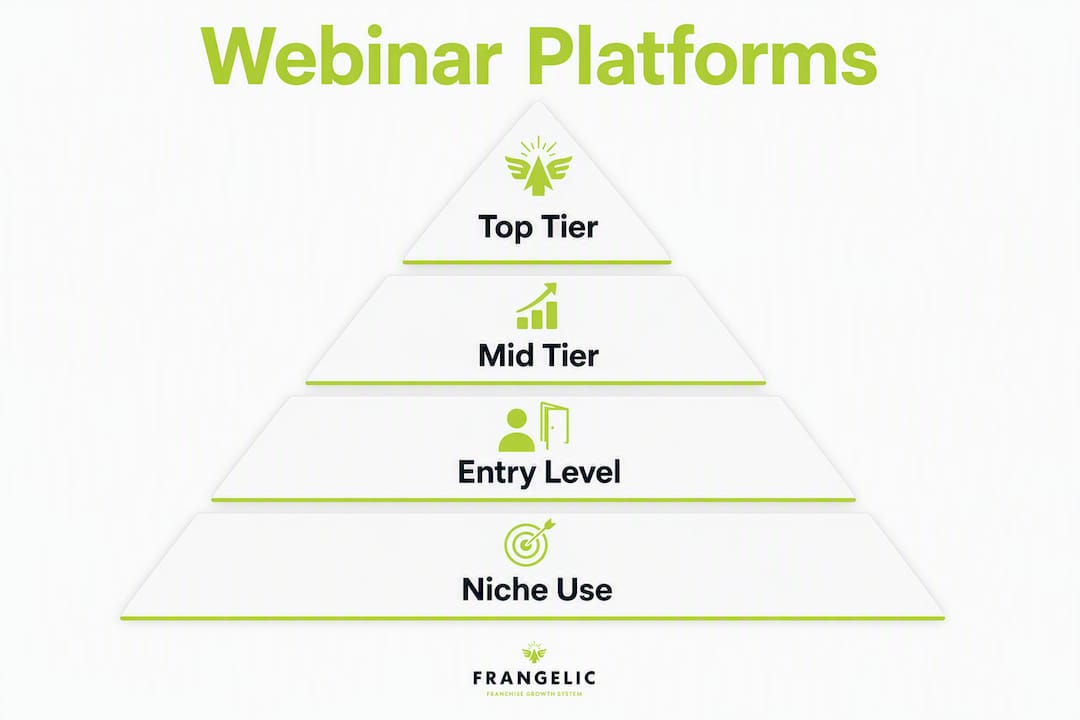
For most marketing-driven webinar programs, Demio is the strongest starting point: browser-based joining, built-in engagement scoring, and automated email sequences that feed directly into your CRM. If you need evergreen automation, eWebinar or EverWebinar are the purpose-built answers. For enterprise scale and security, Zoom Webinars or Webex handle 500-plus attendees reliably. And if you’re running sales-heavy live events, WebinarJam has the conversion tooling built in.
The table below maps the top picks to their primary use case and pricing shape so you can shortlist in under two minutes.
| Platform | Best For | Pricing Shape | Max Live Attendees |
|---|---|---|---|
| Demio | Lead-gen & recurring live programs | Per-host, monthly/annual | — |
| eWebinar | Evergreen/automated funnels | Per-host, monthly | Unlimited on-demand |
| EverWebinar | Evergreen sales funnels | Annual flat | Unlimited on-demand |
| WebinarJam | Live sales events & monetization | Annual flat | Up to 5,000 |
| Zoom Webinars | Large-audience & enterprise town halls | Add-on to Zoom license | Up to 50,000 |
| Webex Webinars | Enterprise security & Cisco stack | Enterprise pricing | Up to 100,000 |
| Livestorm | B2B marketing, browser-first | Per-attendee credits | Up to 3,000 |
| BigMarker | Automated funnels at scale | Custom/enterprise | — |
| ON24 | Enterprise revenue programs | Enterprise contract | Large-scale |
| GoTo Webinar | Reliability, per-organizer pricing | Per-organizer flat | Up to 3,000 |
Try first based on your situation:
- Small marketing team running live lead-gen webinars: Start with Demio or Livestorm. Both are browser-based, require no attendee download, and connect to HubSpot or Salesforce without a Zapier workaround.
- Evergreen or on-demand funnel: eWebinar or EverWebinar. They simulate live interactions on pre-recorded sessions, including timed polls and chat triggers.
- Enterprise or large internal audience: Zoom Webinars if your org already runs Zoom; Webex if you’re in a Cisco environment or need network-grade security.
- Selling during live events: WebinarJam. Its in-webinar offer pages, countdown timers, and high-capacity rooms are built for that exact workflow.
- Tight budget or free start: Google Meet, YouTube Live, or StreamYard On-Air cover the basics at no cost.
Which webinar platforms are worth your time? Full mini-reviews
Webinar-first platforms deliver structured registration pages, automated reminders, and attendee reporting that generic video conferencing tools simply don’t match. That gap matters when your goal is pipeline attribution, not just a video call.
Demio
Browser-based, no download required for attendees. Demio’s engagement scoring tracks who clicked a CTA, answered a poll, or stayed to the end, and it pushes that data to your CRM automatically. Entry pricing starts around $59/month (annual) for one host. On-demand replay is included. Integrations cover HubSpot, Marketo, ActiveCampaign, and Zapier.

Pros: Clean attendee experience, strong marketing automation, built-in engagement data. Cons: Attendee cap lower than enterprise tools; pricing climbs with additional hosts.
BigMarker
Feature-dense with built-in webinar automation, event hubs for multi-session programs, and a landing page builder. Suited for teams running recurring series or large-scale interactive sessions. Pricing is custom/enterprise-tier, so expect a sales conversation.
Pros: Deep automation, multi-session hubs, high attendee capacity. Cons: Pricing opacity; steeper learning curve for smaller teams.
Crowdcast
Built for creators and community managers. Threaded Q&A, multi-destination streaming, and a simple registration flow. Not the strongest CRM integration story, but excellent for community-driven events.

Pros: Community-first UX, multi-streaming, threaded Q&A. Cons: Limited marketing automation; not ideal for enterprise funnels.
WebinarJam
Designed around selling. In-webinar offer pages, countdown timers, panic button (instant room reset), and support for up to 5,000 live attendees. Annual pricing only, which keeps the per-event cost low for high-frequency programs.
Pros: Best-in-class conversion tooling, high capacity, active attendee features. Cons: Annual commitment required; interface feels dated compared to newer tools.
GoTo Webinar
One of the oldest names in the category, and that longevity shows in its reliability. Per-organizer flat pricing makes budgeting predictable. Up to 3,000 attendees on higher tiers. Registration workflows are solid, though the marketing automation is less sophisticated than Demio or Livestorm.
Pros: Reliable, predictable billing, good enterprise support. Cons: UI is dated; marketing workflow features lag behind newer competitors.
ClickMeeting
Strong for structured training and education: course-friendly scheduling, breakout rooms, and a clean attendee experience. Entry pricing is accessible. Not the first choice for sales-heavy or evergreen programs.
Pros: Education-focused features, affordable entry, breakout rooms. Cons: Limited evergreen/automation capability.
EverWebinar
The automated counterpart to WebinarJam (same parent company). Runs pre-recorded sessions on a live-like schedule with timed chat messages, polls, and CTAs. Annual pricing. No live attendee cap in the traditional sense since sessions are pre-recorded.
Pros: Convincing live simulation, timed engagement triggers, pairs well with WebinarJam. Cons: No true live interaction; attendees who probe will notice the automation.
Livestorm
Browser-based, GDPR-conscious, and popular with European B2B teams. Pricing is based on attendee credits rather than a flat host fee, which keeps costs low for small or infrequent events but can get expensive at scale. Analytics are strong. HubSpot, Salesforce, and Pipedrive integrations are native.
Pros: No download, strong analytics, flexible credit pricing, GDPR-ready. Cons: Credit model gets costly for large recurring programs.
WebinarNinja
All-in-one for coaches and consultants: landing pages, payment integrations, and course delivery built into the webinar flow. Affordable entry pricing. Not built for enterprise scale.
Pros: Payment and landing page tools built in, affordable. Cons: Attendee cap lower than enterprise tools; limited CRM depth.
Zoho Webinar / Zoho Meeting
Low entry price and native fit for teams already in the Zoho ecosystem. CRM sync with Zoho CRM is seamless. Outside the Zoho stack, integration options are narrower.
Pros: Affordable, native Zoho CRM sync. Cons: Limited value outside the Zoho ecosystem; fewer third-party integrations.
eWebinar
Purpose-built for automated, on-demand delivery. Human-in-the-loop chat lets a team member respond to attendee messages even on a pre-recorded session. Automated platforms like eWebinar trigger chat, polls, and CTAs at specified timestamps to replicate live engagement. Strong fit for onboarding sequences and evergreen product demos.
Pros: Best automation UX, human chat overlay, strong on-demand analytics. Cons: No live broadcast capability; not a replacement for live events.
Zoom Webinars
The default for large internal town halls. Zoom scales to 50,000 attendees and benefits from near-universal familiarity, which keeps show rates high for internal audiences. Registration and analytics are less marketing-focused than webinar-first tools, and deep CRM workflows typically require Zapier or a third-party connector.
Pros: Massive scale, universal familiarity, reliable. Cons: Marketing workflow is thin out of the box; add-on pricing on top of existing Zoom licenses.
Webex Webinars
Cisco’s offering for enterprises that need network-grade security, compliance controls, and integration with the broader Cisco stack. Supports up to 100,000 attendees; pricing is enterprise-contract territory.
Pros: Enterprise security, massive capacity, Cisco ecosystem integration. Cons: Overkill and expensive for SMB; less marketing-native.
Vimeo / Wistia
Both are video-first platforms that support high-quality streaming and post-production repurposing. Dedicated recording-first platforms often produce cleaner output than standard webinar hosts. Vimeo handles live streaming; Wistia focuses on video hosting with detailed viewer analytics. Neither replaces a full webinar platform for live engagement features.
Pros: Broadcast-quality recording, rich video hosting, strong analytics. Cons: Not full webinar platforms; limited live engagement tooling.
ON24
ON24 is the enterprise standard for organizations that treat webinars as a core revenue channel. Deep analytics, content hubs, and professional services make it powerful, but pricing is enterprise-contract only.
Pros: Deep analytics, content hubs, enterprise services. Cons: Expensive; requires procurement and onboarding investment.
WebinarGeek
European-focused with GDPR considerations built in. Marketing-oriented features including registration pages, email sequences, and basic CRM integrations. A reasonable mid-market option for European B2B teams.
Pros: GDPR-ready, marketing tools, accessible pricing. Cons: Less known in the US market; fewer third-party integrations than Demio or Livestorm.
Whova
Whova is primarily an event management platform that includes webinar and hybrid event capabilities. Best for multi-session conferences and hybrid events rather than standalone marketing webinars.
Pros: Full event management, hybrid support, networking features. Cons: Heavier than needed for a single-session marketing webinar.
Microsoft Teams Webinars
Native to Microsoft 365, with enterprise authentication and compliance controls. Works well for internal audiences already on Teams. Marketing workflow features are limited compared to dedicated webinar tools.
Pros: Native M365 integration, enterprise controls, familiar to internal audiences. Cons: Limited marketing automation; not ideal for external lead-gen events.
LiveWebinar
Flexible streaming and broadcasting to social channels. Feature-rich for the price. Less polished than Demio or Livestorm but covers the core use cases.
Pros: Flexible streaming, affordable, social broadcasting. Cons: UI less refined; smaller community and support base.
Google Meet / YouTube Live / StreamYard On-Air
Free or near-free options for broad-reach broadcasts. YouTube Live reaches the widest public audience of any option on this list. StreamYard On-Air adds a browser-based production layer for multi-guest streams. None of these offer structured registration or CRM-native analytics, so they work best for top-of-funnel awareness rather than pipeline-tracked programs.
Pros: Free or very low cost, wide reach, no attendee friction. Cons: No registration workflow, no CRM sync, limited analytics.
Airmeet
Networking-focused with virtual tables, speed networking, and social lounges. Strong for community events where attendee-to-attendee interaction matters as much as the presentation.
Pros: Best-in-class networking features, social lounges. Cons: Overkill for standard marketing webinars; pricing scales with features.
StreamYard
A browser-based live-streaming studio for multi-destination social broadcasting. Pairs well with YouTube Live or LinkedIn Live for marketers who want simple production without a dedicated webinar platform.
Pros: Multi-platform streaming, simple browser studio, affordable. Cons: Not a full webinar platform; no registration or CRM workflow.
Pro Tip: Before you commit to any platform, run a test registration as an attendee on your own phone. The friction you feel in that 90 seconds is exactly what your audience will experience on event day.
Feature comparison: what actually matters for marketing teams
Pricing shapes vary significantly: per-organizer flat plans like GoTo Webinar and Demio are predictable for recurring programs; Livestorm’s credit model is cheaper for small events but expensive at scale. Browser-based joining correlates with higher show rates because attendees skip the download step entirely.
| Platform | Best For | Pricing Shape | Max Live Attendees | CRM / Integrations | Engagement Tools | Automation / Evergreen | Browser-Based (No Download) |
|---|---|---|---|---|---|---|---|
| Demio | Lead-gen, recurring live | Per-host flat | — | HubSpot, Marketo, ActiveCampaign | Polls, Q&A, CTAs, chat | On-demand replay | Yes |
| Livestorm | B2B marketing | Per-attendee credits | 3,000 | HubSpot, Salesforce, Pipedrive | Polls, Q&A, chat | On-demand replay | Yes |
| eWebinar | Evergreen/automated | Per-host flat | Unlimited (on-demand) | Zapier, HubSpot | Timed polls, chat, CTAs | Full automation | Yes |
| EverWebinar | Evergreen sales funnels | Annual flat | Unlimited (on-demand) | Zapier, basic | Timed chat, polls, CTAs | Full automation | Yes |
| WebinarJam | Live sales events | Annual flat | 5,000 | Zapier, basic CRM | Offers, countdowns, polls | Replay | Partial |
| BigMarker | Automated funnels, scale | Custom/enterprise | — | HubSpot, Salesforce, Marketo | Polls, Q&A, chat, CTAs | Full automation | Yes |
| Zoom Webinars | Large audiences, enterprise | Add-on license | 50,000 | Salesforce, HubSpot (via Zapier) | Q&A, polls, chat | Replay | No (app required) |
| Webex Webinars | Enterprise security | Enterprise contract | 100,000 | Cisco stack, Salesforce | Q&A, polls, chat | Replay | Partial |
| GoTo Webinar | Reliability, per-organizer | Per-organizer flat | 3,000 | Salesforce, HubSpot, Zapier | Polls, Q&A, handouts | On-demand replay | No (app required) |
| ON24 | Enterprise revenue programs | Enterprise contract | Large-scale | Deep CRM/MAP integrations | CTAs, polls, Q&A, content hubs | Full automation | Yes |
| ClickMeeting | Training, education | Per-host flat | — | Zapier, basic | Polls, Q&A, breakout rooms | On-demand replay | Yes |
| WebinarNinja | Coaches, consultants | Per-host flat | — | Zapier, payment integrations | Polls, Q&A, chat | On-demand replay | Yes |
| Zoho Webinar | Zoho ecosystem teams | Per-host flat | 3,000 | Zoho CRM native | Polls, Q&A, chat | On-demand replay | Yes |
| Vimeo / Wistia | Broadcast-quality recording | Per-seat / flat | Varies | Limited | Minimal live tools | Video hosting | Yes |
| WebinarGeek | European B2B | Per-host flat | — | HubSpot, Zapier | Polls, Q&A, chat | On-demand replay | Yes |
| Whova | Hybrid/multi-session events | Event-based pricing | Varies | Event management tools | Networking, Q&A, polls | Limited | Yes |
| Microsoft Teams Webinars | M365 organizations | M365 license | — | M365, Dynamics 365 | Q&A, polls | Replay | Partial |
| LiveWebinar | Social streaming, flexible | Per-host flat | — | Zapier, basic | Polls, Q&A, chat | On-demand replay | Yes |
| Google Meet / YouTube Live / StreamYard | Free/broad reach | Free / low cost | Millions (YouTube) | None native | Chat only | None | Yes |
| Airmeet | Community networking | Per-event / flat | 100,000 | Zapier, HubSpot | Tables, networking, Q&A | Limited | Yes |
| Crowdcast | Creator communities | Per-host flat | — | Zapier, basic | Threaded Q&A, chat | On-demand replay | Yes |
Quick takeaways:
- Enterprise teams — with existing Zoom or Microsoft 365 infrastructure should start there and layer in a marketing automation tool rather than switching platforms entirely.
How we evaluated these platforms
Every platform in this roundup was assessed against eight criteria: registration and funnel workflow, CRM and marketing automation integrations, engagement tooling (polls, Q&A, CTAs, handouts), automation and evergreen capability, video quality and reliability under load, pricing model and total cost of ownership, data portability and export options, and support and onboarding quality.
Hands-on testing covered real webinar runs, not just feature demos. Metrics tracked included attendance rate, drop-off by session segment, CTA click-through, and CRM record fidelity post-event. Vendor documentation, third-party pricing pages, and published user reviews on G2 and Zapier’s roundup were cross-referenced to verify feature claims.
“Enterprise-grade options often include dedicated onboarding and account management at higher price tiers, while SMB-focused tools rely on self-service and community support. Knowing which tier you’re buying into before you sign matters as much as the feature list.” — Zapier’s webinar software roundup
Evaluation criteria summary:
- Registration workflow and landing page quality
- CRM sync fidelity (native vs. Zapier-dependent)
- Engagement tools available during live sessions
- Automation and evergreen session capability
- Video quality and platform reliability at stated attendee caps
- Pricing model clarity and total cost for recurring programs
- Data export and attendee data ownership
- Support tier and onboarding resources
This review reflects platform capabilities and pricing as of early 2026. Vendor pricing changes frequently; always verify current plans directly with the vendor before purchasing.
How to choose the right webinar platform for your program
Platform choice should be driven by your primary event goal. Sales webinars need conversion features; training webinars need breakout rooms and persistent attendee history. A single platform rarely does both optimally, so start with your dominant use case.
Decision checklist:
- Define your primary event goal. Lead generation, sales conversion, onboarding/training, community building, or evergreen content delivery? Each maps to a different feature priority.
- List your required integrations. Which CRM, MAP, or LMS must receive attendee data automatically? If the platform requires Zapier for a core integration, factor in that dependency and its cost.
- Estimate your audience size and friction tolerance. Internal audiences tolerate app downloads; external prospects often don’t. Browser-based joining reduces friction and correlates with higher show rates.
- Decide on automation needs. Do you need live-only, on-demand replay, or fully automated evergreen sessions? These are three different product categories.
- Map your budget shape. Per-organizer flat pricing (GoTo Webinar, Demio) is predictable for recurring programs. Per-attendee credit models (Livestorm) are cheaper for small events but expensive at scale.
- Plan a two-week proof-of-concept. Run one pilot webinar with your actual CRM and registration workflow before committing to an annual plan.
Questions to ask vendors:
- Who owns the attendee data, and can you export it in full at any time?
- Does the platform support native embedding on your own domain?
- What is the SLA for live event support, and is it included in your tier?
- Can automated sessions trigger CRM activity records in real time?
Red flags that should disqualify a vendor:
- No native CRM sync and no documented Zapier integration
- Mandatory attendee app download with no browser fallback
- Pricing that requires a sales call to get a number
- No automated replay or evergreen option when your program needs it
- Attendee data locked in the platform with no export
Pro Tip: Run your proof-of-concept with a real segment of your audience, not internal testers. Internal testers tolerate friction that external prospects won’t. Track registration-to-attendance rate and CRM record creation as your two pass/fail metrics.
Match your webinar goal to the features you actually need
Successful webinar programs prioritize CRM handoffs, registration fidelity, and automation that drives follow-up conversion over raw production features. The table below maps common goals to the features that actually move the needle.
| Webinar Goal | Must-Have Features | Recommended Platforms |
|---|---|---|
| Lead generation | Registration pages, CRM sync, automated follow-up emails, engagement scoring | Demio, Livestorm, BigMarker |
| Live sales / conversion | In-webinar CTAs, offer pages, countdown timers, high capacity | WebinarJam, BigMarker |
| Onboarding / training | Breakout rooms, persistent attendee history, LMS integration, exportable records | ClickMeeting, GoTo Webinar, Zoom Webinars |
| Community building | Networking features, threaded Q&A, multi-streaming | Airmeet, Crowdcast |
| Large-scale broadcast | —+ capacity, reliability, enterprise support | Zoom Webinars, Webex, ON24 |
| Evergreen / automated funnels | Timed engagement triggers, human-in-the-loop chat, CRM activity records | eWebinar, EverWebinar, BigMarker |
Three example workflows:
Lead-gen webinar feeding HubSpot: Use Demio or Livestorm. Attendee registers via a native landing page, receives automated reminder emails, joins browser-based, and their engagement score (poll answers, CTA clicks, watch time) syncs to a HubSpot contact record within minutes of the session ending. No Zapier required.
On-demand training synced to an LMS: ClickMeeting or GoTo Webinar for the live session, with recording exported to your LMS. Attendee completion data and quiz results feed back via integration. For distributed franchise teams, browser-based access matters: requiring a download creates measurable drop-off across locations.
Evergreen sales webinar with CTA tracking: eWebinar hosts the pre-recorded session on a rolling schedule. Timed chat messages and polls fire at the same timestamps as the original live session. When an attendee clicks the CTA, the event triggers a CRM activity record and enrolls them in a follow-up sequence automatically.
Pro Tip: Treat every webinar attendance as a CRM activity record, not just a list entry. Platforms that write granular in-webinar actions (poll answered, CTA clicked, drop-off timestamp) directly to your CRM contact record make automated nurture sequences far more precise than a simple “attended/did not attend” flag.
Key Takeaways
The strongest webinar platform for most marketing teams is one that connects registration, engagement, and CRM data in a single workflow, not the one with the longest feature list.
| Point | Details |
|---|---|
| Browser-based joining matters | No-download platforms correlate with higher show rates, especially for external audiences. |
| Match platform to goal | Sales events need conversion tools; training needs breakout rooms and attendee history; evergreen needs automation. |
| Pricing model affects total cost | Per-organizer flat plans are predictable; per-attendee credit models get expensive at scale. |
| CRM sync is the core metric | Platforms with native CRM integration produce more reliable pipeline attribution than those requiring Zapier workarounds. |
| Frangelic for franchise training | Frangelic’s structured coaching system integrates webinar-driven training into a CRM-connected franchise growth program. |
Useful sources and vendor links
- WebinarNinja: Free Webinar Software Options
- Zapier: Best Webinar Software for Marketers
- Zoom Webinars Product Page
- Frangelic: Franchise Coaching and Training
Frangelic brings a different approach to webinar-driven franchise training
The platforms compared above are tools. What most franchise organizations actually need is a system that tells them how to use those tools to move revenue, not just a software license.
Frangelic’s structured coaching and training system is built for franchisors and franchisees who want webinar-driven training that connects directly to growth outcomes. Rather than handing you a platform and leaving you to figure out the funnel, Frangelic delivers a defined plan: customizable launch and growth programs, marketing training, CRM integration guidance, and live group coaching sessions that run on whichever webinar platform fits your stack. The result is a franchise training program that reduces support team workload, improves franchisee decision-making, and creates measurable revenue momentum.
If you’ve read this far and your real question is “how do we build a webinar-based training system that actually drives franchise growth,” that’s exactly what Frangelic is built for. Book a strategy session to see how the system maps to your franchise program.