
Pair Call Tracking Tech and Coaching: 90 Day Franchise Pilot
Call tracking for franchises works by assigning trackable numbers to each location and campaign, then routing, recording, and scoring every inbound call so franchisors can see exactly which marketing drives sales at each store. Done right, it produces three things at once: accurate per-location attribution, smarter call routing, and coaching-ready conversation data. The checklist and KPIs later in this article show you how to get all three without drowning franchisees in dashboards they’ll never open.
TL;DR:
- Location-based routing and individual number tracking reveal which campaigns and channels drive sales for each franchise outlet, preventing wasted ad spend.
- Call tracking platforms should include dynamic number insertion, role-based dashboards, AI transcription, and CRM integration to connect calls directly to revenue.
- A phased rollout starting with a pilot program ensures data accuracy and franchisee buy-in, reducing setup time with bulk provisioning and number porting.
- Key KPIs include call source, missed calls, and conversion rates, with AI scoring used to assess staff performance and improve service quality.
- Combining call data with structured coaching accelerates performance improvements and turns analytics into tangible sales growth.
Why Call Tracking Matters for Franchise Networks
Franchise marketing runs on shared budgets that hide individual results. A national brand campaign might pull 500 calls across 40 locations, but without location-level tracking, nobody knows if that spend converted three sales in Phoenix and zero in Tulsa. Co-op advertising funds make this worse because franchisees pay into a pool they can’t directly measure against their own store’s phone.
Phone calls still close deals in ways clicks don’t. Home services, auto repair, dental, and restaurant franchises routinely see callers convert at higher rates than web form submissions, because a person on the phone is already past the research phase. When a franchise loses track of who’s calling and why, it loses the clearest signal it has about which local tactics actually work.
Territory-based routing and per-location number assignment fix the accountability gap directly:
- Franchisees see their own call volume and conversion rate, not a blended network average.
- HQ can compare stores on equal footing and spot underperformers before quarterly numbers reveal it.
- Wasted co-op spend on channels that generate calls but no sales becomes visible fast.
- Regional managers get a tool to coach with data instead of opinion.
The result is a marketing budget that finally has a paper trail from ad dollar to phone call to closed sale.
Core Capabilities Every Franchise-Grade Call-Tracking Program Needs
Not every call-tracking tool built for a single small business scales to a 50 or 200 unit network. Before evaluating vendors or writing internal requirements, franchises need to check for six specific capabilities.
- Territory-based routing and IVR. Callers dialing a national number should land at the correct local store automatically, with business-hours rules and failover routing when a location doesn’t answer, supported by AI voice agents like those at Wattle to improve call handling efficiency. Franchise-specific platforms like QIVIR build location-finder IVR and mapping integrations specifically to route callers by zip code or service territory, which matters more than keyword tracking when franchise boundaries overlap.
- Dynamic number insertion (DNI) that swaps in a unique tracked number per visitor based on the campaign or channel that brought them to a page, so you can attribute a call to a specific ad, not just “the website.”
- Scoped per-location numbers and dashboards with role-based access, so a franchisee sees their own store’s data while regional and corporate users see roll-ups across territories.
- AI transcription and call scoring. Platforms in this space, including Invoca, now transcribe and score inbound calls automatically for intent, outcome, and staff performance, turning raw call volume into a coaching tool instead of a vanity metric.
- CRM, ad platform, and POS integrations that connect a call to a closed sale, not just a lead. Without this link, you’re measuring activity, not revenue.
- Bulk provisioning and API support for number porting and rollout at scale, since manually setting up numbers for many locations one at a time isn’t realistic.
Pro Tip: Ask any vendor how their platform handles a franchisee who leaves the network mid-year. Number reassignment, historical data ownership, and account transfer rules get overlooked in the sales demo and become a mess later.
How to Roll Out Call Tracking Across Multiple Locations
Franchise call-tracking rollouts fail most often because someone tries to launch every location at once. A phased approach protects data quality and franchisee buy-in.
- Set goals, KPIs, and a data ownership matrix first. Decide who at HQ sees network-wide data, who at the regional level sees territory data, and what a franchisee can see about their own store before a single number gets provisioned.
- Map territories and identify which assets need unique numbers. Every paid campaign, every location’s Google Business Profile, and every major landing page usually needs its own trackable number if you want clean attribution.
- Choose a provisioning approach. A single shared script with dynamic number insertion can serve an entire multi-location domain, assigning unique display numbers per location without a separate script for every site, which cuts setup time dramatically compared to per-location scripts.
- Run a pilot with 10 to 30 locations. Validate that call routing and attribution are working correctly before scaling. Vendors have documented rollouts scaling past 200 locations once the pilot phase confirms the setup catches phone-system issues early.
- Integrate CRM, POS, and ad platforms, then set automated alerts for anomalies like a sudden call-volume drop or a spike in missed calls at one location.
- Train franchisees on their dashboard, the reporting cadence, and exactly when to escalate a problem to their regional manager instead of guessing.
Pro Tip: Bulk provisioning through a CSV upload and number porting through your carrier partner can shrink time-to-live for a new location from weeks to days, according to platform guidance from Nimbata. Build that into your rollout timeline instead of assuming manual setup.
Measuring Success: KPIs and Tying Calls to Revenue
Four KPIs matter more than the rest: calls by source, missed-call rate, call-to-lead conversion, and call-to-sale revenue pulled from your CRM or POS system. Without that last one, you’re reporting call volume, not business impact.
AI call scoring adds a second layer of quality KPIs that pure volume metrics miss entirely:
- Greeting and script compliance, scored automatically across every call instead of a manager spot-checking one recording a month.
- Follow-up action completion, flagging when a promised callback never happened.
- Upsell or cross-sell attempts, which show whether staff are converting inbound interest into larger tickets.
Franchisors who connect CRM and POS data to call records turn a marketing report into a revenue report, since a location generating 200 calls a month means nothing if only four convert to paying customers.
Build per-location scorecards that roll up into a network dashboard for quarterly reviews, and keep the franchisee-facing version simple. Franchisees respond better to three or four numbers, like total calls, missed calls, and average response time, than to a dashboard with 40 metrics competing for attention. Set alerting thresholds too. A location whose call volume drops 30% week over week, or whose missed-call rate suddenly spikes, needs a flag in someone’s inbox that same day, not a note buried in a monthly PDF nobody reads until it’s too late to matter.
Common Pitfalls in Franchise Call Tracking
The single biggest mistake franchises make is choosing a call-tracking tool built for a single storefront and trying to bolt on multi-location features later. Fragmented data and manual spreadsheet aggregation are the predictable result. Platforms designed for franchise hierarchy from the start avoid this by building HQ roll-ups and scoped local logins into the core product.
Governance issues show up next, usually around who can change a tracked number, who owns SLAs for call handling, and how disputes over misrouted calls get resolved between neighboring territories.
- Require change control on marketing numbers so no single franchisee can swap a tracked number without HQ visibility.
- Set role-based access before launch, not after a data leak between competing franchisees.
- Configure recording settings per state, since one-party and two-party consent laws for call recording vary by state and a single blanket setting can create legal exposure.
- Test number porting and monitor for number conflicts before a campaign goes live, not during it.
- Automate missed-call alerts so a broken phone line at one location gets caught in hours, not weeks.
Pro Tip: Two-party consent states require notifying callers that a call may be recorded. Configure this at the location level, not the network level, since a franchise operating across state lines can’t use one disclosure setting for every store.
Frangelic’s Playbook: Turning Call Data Into Behavior Change
A dashboard full of accurate call data doesn’t move revenue on its own. A coaching model can close that gap by pairing weekly scorecards with targeted coaching sessions, so a franchisee who sees a missed-call spike gets a specific conversation about front-desk staffing, not just a number in a report.
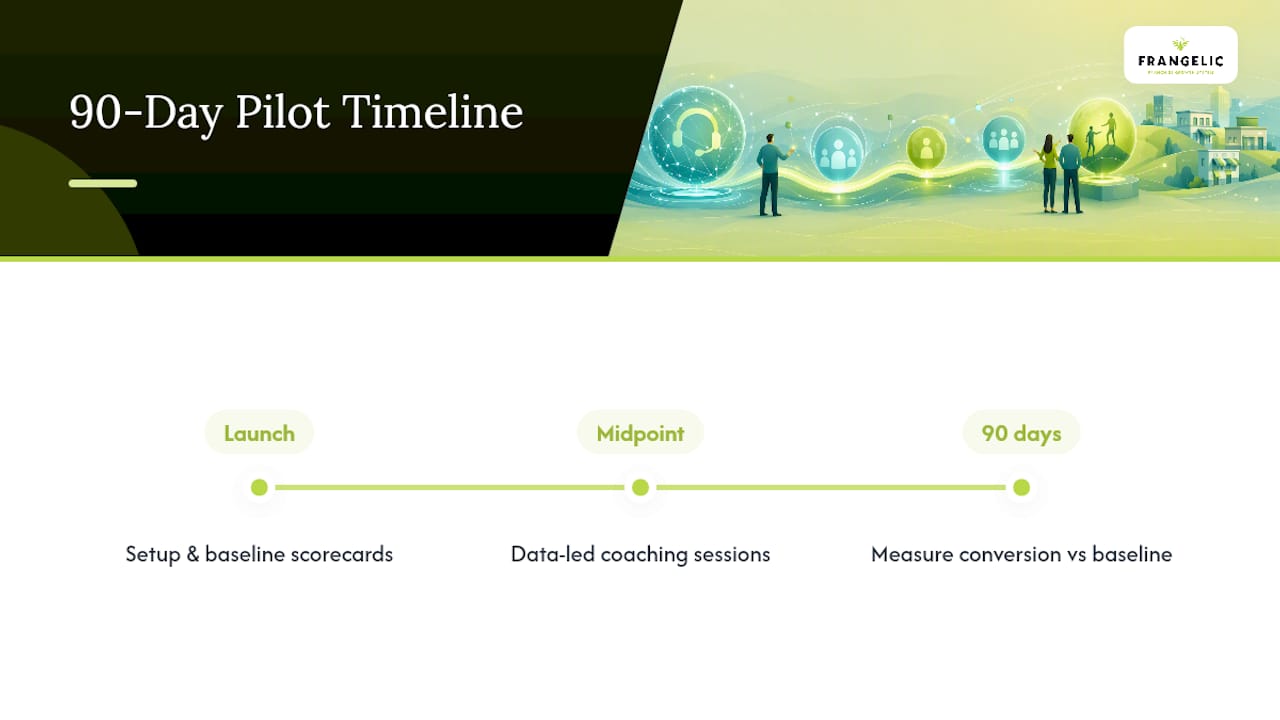
A typical pilot runs 90 days: the initial phase focuses on setup and baseline scorecards, followed by coaching sessions based on call data, concluding with measuring conversion lift against the baseline. Owner accountability comes from making the scorecard visible and specific, not from a corporate memo about “improving customer service.”
The pattern seen across franchise coaching engagements is consistent: locations that pair platform data with structured coaching close performance gaps faster than locations relying on the dashboard alone. Data tells you where the problem is. Coaching is what actually changes what happens on the next call. Combining the two, rather than treating analytics as a standalone project, is what turns call tracking from a reporting exercise into a same-store sales growth lever.
Get Help Turning Call Data Into Growth
A company may not sell call-tracking software but instead sell the coaching system that makes the software’s data actually change what happens at the store level, which is where most franchises get stuck after they’ve already bought the platform.
Once the numbers start flowing, most franchisors face the same question: now what? That’s where structured coaching earns its keep. Providers can help franchisors define the right KPIs before rollout, support the pilot phase so early data doesn’t get misread, train franchisees on how to actually use their dashboards, and build the governance rules that keep many locations reporting the same way. The goal isn’t another tool. It’s a system that turns call analytics into a repeatable coaching cadence tied to unit economics and revenue, not just call volume.
If your network has call data sitting unused, or you’re about to roll out tracking without a plan for what happens after launch, book a session with Frangelic to build the coaching layer around it.
Sources
- Enterprise Call Tracking Platform for Franchise Businesses
- Multi-Location & Franchise CX | Invoca
- Call Tracking, QR Code Tracking and Call Routing Built for Franchise Brands
- Call management for franchise & multi-location businesses | Delacon
FAQ
How Much Does Call Tracking Cost for a Franchise?
Pricing typically runs on a subscription model with per-location tiers or custom enterprise quotes for larger networks; AvidTrak, for example, offers a 14-day free trial before committing to an enterprise plan. Exact costs depend on call volume, number of locations, and whether AI transcription and scoring are included.
Can a Franchise Track Call History Across Locations?
Yes. Multi-location platforms log call history per number and per location, then roll that history up into network-wide reports while keeping franchisee-level dashboards scoped to their own store’s data.
What Is the Best Software for Tracking Sales Calls in a Franchise?
The best option is the one built specifically for multi-location hierarchy, with territory routing, DNI, scoped dashboards, and CRM or POS integration rather than a single-location tool retrofitted for scale. Look for platforms that also offer AI call scoring so raw volume turns into coaching data.
How Long Does It Take to Roll Out Call Tracking Networkwide?
A pilot of 10 to 30 locations typically takes a few weeks to validate, after which bulk provisioning and number porting can bring new locations live in days rather than weeks. Full networkwide rollout depends on total location count and how quickly franchisees complete training on their dashboards.
Does Call Tracking Data Actually Improve Franchise Revenue?
It improves revenue when the data gets acted on, not just reported. Pairing call analytics with structured coaching, the way Frangelic builds into its franchise rollout playbook, is what typically converts tracking data into measurable conversion gains at the store level.