
Franchise Brand Compliance: An Operations Playbook
Prioritize your highest-risk units first, run a rapid audit sample within 30 days, and close every corrective action plan (CAP) within 14 days. That sequence, applied consistently, is what separates brands that scale cleanly from those that spend years firefighting. Under the FTC Franchise Rule, franchisors must deliver a Franchise Disclosure Document to prospects at least 14 calendar days before signing any binding agreement or accepting payment. That is the legal floor. Everything above it, governance, scorecards, training, audit cadence, is the architecture that determines whether your brand actually holds together across 50 or 500 locations.
Your 30/60/90 quick-start checklist:
- Day 1–30: Assign a compliance owner, pull a 10-unit audit sample weighted toward your highest-risk locations, and identify your top five open CAPs. Close or escalate each one.
- Day 31–60: Define your scorecard (weighted by risk category), run a pilot corrective-action loop with your sample group, and select your LMS and audit platform.
- Day 61–90: Roll out the scorecard to all units, launch role-based training for GMs, and set a dashboard threshold that triggers automatic escalation.
Pro Tip: Track CAP close time from day one. Units that close items quickly show materially lower repeat-violation rates, so that single metric tells you more about long-term compliance health than any snapshot audit score.
Key Takeaways
A franchise brand compliance program only holds at scale when legal obligations, operational standards, training, and monitoring connect in a closed loop, with named owners and measurable KPIs at every stage.
| Point | Details |
|---|---|
| Legal floor is not the program | The FTC Franchise Rule sets the 14-day FDD timing floor; operational architecture above it determines actual brand consistency. |
| CAP close time predicts outcomes | Units closing corrective action items within 14 days show materially lower repeat-violation rates over time. |
| Unannounced audits capture more variance | Structured audits with unannounced checks correlate with materially fewer violations across the network. |
| Training must be role-based and verified | Completion clicks are not competency; tie module sign-off to observable performance and track first-90-day audit pass rates. |
| Coaching before punishment reduces escalation | Top-performing franchisors use training and counseling first to determine whether non-compliance stems from misunderstanding or resource gaps. |
What does a franchise brand compliance program actually require?
Every durable compliance program rests on six pillars. Miss one and the others compensate poorly.
- Governance and roles: Someone owns compliance. That means a named compliance lead, a defined escalation path, and a documented decision-rights matrix covering who can approve exceptions.
- Brand standards and SOPs: Written standards that translate FDD obligations into observable, auditable behaviors at the unit level. As Waldrop & Colvin note, the FDD is the legal floor, not the operational program.
- Training and certification: Role-based modules with competency checks, not just completion clicks. New GMs and tenured operators need different tracks.
- Monitoring and audits: A mix of announced, unannounced, and remote checks on a risk-tiered cadence. Documentation without a delivery mechanism produces no operational consistency.
- Corrective-action workflows: A closed-loop CAP process with defined owners, deadlines, and evidence requirements. Speed matters: 14-day closure targets correlate with lower repeat violations.
- Data, KPIs, and technology: Dashboards that surface risk before it becomes a pattern. Scorecards, photo verification, and real-time field data replace the thick binder.
The pillars connect in sequence: governance sets the rules, standards define the target, training builds capability, monitoring measures reality, and remediation closes the gap. Skipping the governance layer and jumping straight to audits is one of the most common mistakes in franchise strategy development.
How do you implement a compliance program step by step?
A phased rollout prevents the common failure mode of launching everything at once and sustaining nothing.
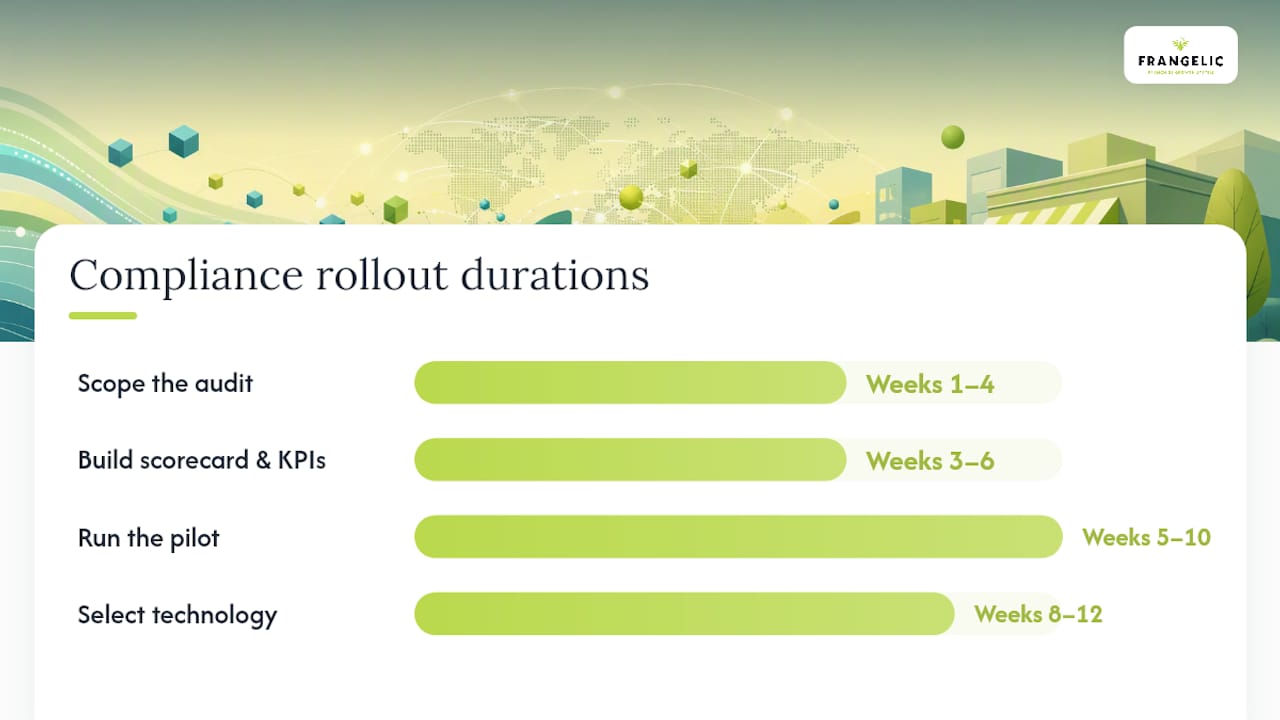
- Scope the audit (Weeks 1–4). Pull a 10-unit sample, weighted toward high-risk or high-volume locations. Define what “compliant” means for each standard before scoring anything.
- Build the scorecard and KPIs (Weeks 3–6). Weight items by risk category. Safety and food-handling items carry more weight than décor standards. Set your CAP close-time target and training-completion threshold.
- Run the pilot (Weeks 5–10). Apply the scorecard to your sample group. Run the full corrective-action loop: finding, CAP assignment, evidence collection, closure. Calibrate your auditors against each other.
- Select technology (Weeks 8–12). Choose your audit platform, LMS, and CAP ticketing system based on integration capability and mobile-first field use.
- Phased rollout (Months 3–6). Expand by region or risk tier, not all at once. High-risk regions go first.
- Governance checkpoints (Month 6 and Month 12). Review scorecard weights, update SOPs for any standard changes, and publish a network-wide compliance report.
Structured operational audits correlate with materially fewer violations across the network, and unannounced checks capture significantly more operational variance than scheduled ones. Build both into your cadence from the pilot phase forward.
Budget bands by system size:
- Small systems (under 25 units): Audit labor and SOP documentation dominate costs. Tech licensing is minimal.
- Mid-market (25–150 units): LMS build and field resource costs rise. A dedicated compliance coordinator becomes necessary.
- Enterprise (150+ units): BI dashboarding, regional field teams, and CRM integration drive the largest cost buckets.
Without a gate, rollout happens on schedule rather than on readiness.*
How do you design training that actually changes behavior?
Training that changes behavior is role-specific, competency-verified, and tied directly to audit KPIs.
- Role-based modules: New GMs need a full onboarding track covering brand standards, SOP walkthroughs, and a first-90-day audit prep module. Tenured operators need recertification focused on updated standards and repeat-violation categories.
- Blended delivery: Combine LMS coursework with live group coaching and in-person walkthroughs. Microlearning modules (under 10 minutes) improve completion rates for time-pressed operators.
- Competency checks tied to SOPs: A quiz score is not a competency check. Require demonstrated performance, a photo submission, a role-play, or a supervisor sign-off before marking a module complete.
- Leading KPIs from training: Track first-90-day audit pass rates, checklist completion rates, and role-competency scores. These predict audit outcomes before the auditor arrives.
Pro Tip: Pair small-group peer review sessions with coaching rather than relying solely on LMS completion. When operators discuss real CAP findings with peers, adoption rises and the tone stays collaborative rather than punitive, which aligns with the carrot-and-stick approach top-performing franchisors use.
What monitoring methods and KPIs actually predict compliance failure?
Audit cadence by risk tier:
- High-risk units: Unannounced quarterly audits plus monthly remote photo checks.
- Standard units: Semi-annual announced audits plus quarterly remote checks.
- Units under CAP: Weekly internal audits until two consecutive clean scores.
The ExeSketch SOP template recommends a monthly minimum internal audit cadence for food service and retail, with weekly checks during active corrective action. That cadence, when mirrored internally by franchisees, produces higher franchisor inspection scores and fewer repeat failures.
Scorecard design principles: Weight items by risk category. A flat 1-point-per-item scorecard hides the difference between a missing sign and a food-safety violation. Track repeat violations separately from first-time findings. CAP close time is a leading indicator; audit score is a lagging one.
Monitoring mix:
- Field inspections for full rubric scoring
- Photo verification for remote spot checks between visits
- Mystery shopping for customer-experience standards
- Automated remote checks (IoT sensors, POS data flags) for high-frequency operational data
How should you handle enforcement and remediation fairly?
Progressive discipline works when it is predictable and documented. The sequence: education and coaching first, then a formal CAP, then probationary monitoring, then contractual remedies if the pattern continues.
CAP template elements:
- Finding (specific standard violated, with audit reference)
- Required corrective action (observable and measurable)
- Owner (named franchisee contact)
- Acceptable evidence (timestamped photo, receipt, training record)
- Deadline (default 14 days; safety items 48–72 hours)
Incentive approaches before escalating:
- Publish a compliance recognition program. Name top-scoring units in network communications.
- Offer reduced audit frequency as a reward for sustained clean scores.
- Provide coaching resources, not just citations, when a CAP is opened.
- Use peer-to-peer coaching to connect struggling units with high-performers before formal discipline.
Pro Tip: When a franchisee pushes back on a CAP, ask whether the violation stems from misunderstanding the standard or from a resource gap. That distinction determines whether the right response is retraining or operational support, and it keeps the relationship from turning adversarial.
What does the FTC Franchise Rule require, and how does it connect to operations?
The FTC Franchise Rule requires franchisors to provide a complete FDD to every prospect at least 14 calendar days before signing any agreement or accepting any payment. No exceptions for “soft commitments” or letters of intent that include fees.
Item 19 of the FDD (financial performance representations) directly shapes what franchisors can claim in sales conversations and marketing materials. Every operational metric you publish in Item 19 must be defensible with documented unit-level data.
Practical steps for ongoing legal compliance:
- Log every material change to operations, fees, or litigation between annual FDD updates. A change log is your first line of defense in a disclosure dispute.
- Run a legal review checkpoint whenever you update brand standards that affect franchisee obligations or costs.
- Verify state registration status before offering or selling in registration states. Fourteen states require active registration beyond the federal FTC filing.
- Involve franchise counsel before publishing any advertising claim that references system-wide performance.
Pro Tip: Treat the FDD change log as a living compliance document, not an annual filing task. Counsel review of mid-year operational changes costs far less than defending an undisclosed material change in arbitration.
What tools and templates does a scalable compliance program need?
Minimum tech stack by system size:
- Small systems: Mobile audit checklist app with photo capture, a basic LMS (TalentLMS or similar), and a shared CAP tracker (even a structured spreadsheet works at this stage).
- Mid-market: Dedicated compliance/audit platform with geotagging and closed-loop CAP workflows, a full LMS with role-based tracks, and a BI dashboard pulling audit and training data.
- Enterprise: Integrated compliance platform, LMS with API connections to HR systems, CRM integration for disclosure workflow tracking, and a real-time BI layer for regional benchmarking.
Templates to build internally:
- Audit checklist (mirroring the franchisor rubric, weighted by risk)
- CAP template (finding, standard, action, owner, evidence, deadline)
- Training module outline (role, learning objectives, competency check, SOP reference)
- FDD change log (date, change description, materiality assessment, counsel sign-off)
- Standard-update communication template (what changed, why, effective date, training required)
Criteria for tool selection: mobile-first field use, photo and geotagging capability, closed-loop CAP workflows, integration with your LMS and CRM, and an audit trail that is exportable for legal review.
Pro Tip: Assign a named internal owner for each tool from day one. A compliance platform with no designated administrator becomes shelfware within 90 days.
How Frangelic integrates coaching with compliance programs
A structured coaching and training system does something a compliance checklist alone cannot: it converts documented findings into changed behavior. Frangelic’s approach layers scorecards, role-based training, and live group coaching directly onto existing audit programs, so corrective action becomes a learning loop rather than a paper trail.
A pilot overlay with Frangelic typically involves:
- Identifying the 10–15 units with the highest CAP volume or lowest audit scores
- Enrolling their GMs and owners in role-based training tracks aligned to the specific standards they are failing
- Running monthly group coaching sessions where operators review real audit findings with peers
- Tracking training completion, CAP close rate, audit score movement, and support ticket volume as pilot KPIs
The franchise marketing systems Frangelic builds alongside compliance training mean brand standards extend to local marketing execution, not just operational SOPs. That matters because inconsistent local marketing is one of the most visible brand-consistency failures a customer ever sees.
Top-performing franchisors use coaching before punitive enforcement to determine whether non-compliance stems from misunderstanding or resource gaps. Embedding that coaching step inside the CAP workflow, rather than treating it as a separate HR function, is what Frangelic’s system makes operationally practical.

Pro Tip: Measure support ticket volume alongside audit scores during the pilot. A drop in inbound support requests from coached units is one of the clearest signals that training is producing genuine self-sufficiency, not just compliance theater.
How do you handle non-compliance disputes and legal considerations?
When a franchisee disputes a compliance finding, the resolution path matters as much as the outcome. Document every step: the original finding, the franchisee’s response, any coaching or retraining offered, and the final determination. That record is your defense if the dispute escalates to arbitration or litigation.
Practical guidance for dispute management:
- Separate the finding from the relationship. Address the specific standard violation in writing before any conversation about consequences.
- Offer a cure period before formal remedies. Most franchise agreements include a cure period (commonly 30 days for non-safety violations). Use it.
- Involve franchise counsel early when a franchisee signals intent to dispute. A letter from counsel at the right moment often resolves disputes that would otherwise become arbitration.
- Never modify a franchise agreement informally. Side agreements and verbal accommodations create enforceability problems. All modifications go through counsel and are documented in writing.
- Track dispute patterns by region and violation type. Recurring disputes around the same standard usually signal a drafting ambiguity in the FDD or SOP, not a franchisee problem.
How do you update standards and communicate changes to franchisees?
Standard updates fail most often not because the new standard is wrong, but because the communication is vague and the training lags the announcement by weeks.

A reliable update process runs in four steps. First, draft the updated standard with input from a franchisee advisory council or a representative operator group. Operators who helped shape a change are far more likely to implement it without resistance. Second, run a legal review to confirm the change does not create an undisclosed material obligation under the FDD. If it does, update the FDD before rolling out the standard. Third, publish the change with a clear effective date, a plain-language explanation of what changed and why, and a training requirement tied to it. Fourth, verify adoption through your next audit cycle and track completion against the effective date.
The communication itself should use multiple channels: a written notice in your franchisee portal, a live webinar or recorded video walkthrough, and a follow-up in your next group coaching session. Relying on a single email announcement is how standards get missed.
How do you build genuine franchisee buy-in for compliance programs?
Franchisees comply consistently when they understand why a standard exists, not just what it requires. That distinction drives everything about how you design and communicate your program.
Practical buy-in strategies:
- Involve franchisees in standard development. A franchisee advisory council that reviews proposed standards before rollout reduces resistance and surfaces operational problems before they become compliance failures.
- Share network-level data. When franchisees see that high-scoring units outperform low-scoring ones on customer satisfaction or revenue metrics, compliance becomes a business argument, not just a contractual obligation.
- Recognize compliance publicly. A monthly or quarterly recognition of top-scoring units in network communications costs nothing and changes the culture around audits.
- Frame audits as support visits, not inspections. Field consultants who arrive with coaching resources alongside their scorecard build trust. Franchisees who trust the process report findings honestly rather than hiding problems until they escalate.
- Build a strong franchisor-franchisee relationship as the foundation. Compliance programs imposed on a fractured relationship produce grudging minimum compliance. Programs built on mutual accountability produce genuine brand consistency.
Primary sources and further reading
The sources below back the legal citations, audit methodology, and SOP guidance in this article. Each one serves a specific implementation purpose.
- FTC Franchise Rule Compliance Guide: The primary legal reference for FDD timing, disclosure requirements, and what constitutes a material change. Verify every disclosure obligation here before updating your FDD.
- Waldrop & Colvin Franchise Compliance Guide: Practitioner-level guidance on mapping FDD obligations to auditable operational behaviors and maintaining procedures for material changes between annual updates.
- FieldPie: Franchise Operational Audits: Covers audit cadence, scorecard design, unannounced vs. announced checks, and CAP close-time data. Use this for audit methodology design.
- ExeSketch Franchise Quality & Compliance Audit SOP Template: A downloadable SOP template with internal cadence recommendations, photographic evidence requirements, and CAP verification guidance.
- Franchise: Practitioner workshop covering the carrot-and-stick compliance model, franchisee engagement strategies, and how top franchisors structure enforcement to reduce alienation.
For implementation support, including training system design, scorecard development, and coaching integration, visit Frangelic to explore the structured coaching and training system built specifically for franchise growth.
This article is general information, not a substitute for advice from a qualified lawyer. Consult a qualified legal professional about your own circumstances before acting on anything here.
Sources
- Franchise Rule Compliance Guide | Federal Trade Commission
- Franchise Compliance Guide for Franchisors | Waldrop & Colvin
- Franchise Operational Audits: Improve Brand Consistency
- Franchise