

Franchise Coaching for Owners: A 2026 Growth Guide
Franchise coaching is the structured process of guiding franchise owners to improve operations and grow revenue through targeted support, accountability, and strategic decision-making. Unlike generic business consulting, franchise coaching addresses the specific pressures franchisees face: brand compliance, local market execution, and the gap between what the franchisor promises and what the owner actually experiences day to day. The first 90 to 180 days of operations are the most critical window for coaching involvement, setting the trajectory for long-term profitability. Structured programs typically start around $1,600 per month with performance guarantees built in. That investment reflects how seriously the industry treats coaching as a growth driver, not a luxury.
What does franchise coaching actually do for owners?
Franchise coaching is a hands-on support system, not a motivational seminar. A franchise coach, often called a Field Business Coach (FBC), works alongside owners from pre-opening milestones through ongoing performance monitoring. The role blends three distinct functions: strategic partner, accountability enforcer, and early-warning system for operational problems.
The early-warning function is where coaching earns its keep. FBCs carry a bird’s-eye view across multiple locations, which means they spot patterns that individual owners miss entirely. Declining membership numbers, rising customer complaints, and staff turnover often show up in coaching data weeks before they appear in a franchisee’s own reporting.
Day-to-day coaching activities include reviewing KPI dashboards, running structured check-in calls, identifying gaps between brand standards and local execution, and helping owners prioritize the decisions that matter most. A coach does not just tell you what to fix. A coach helps you understand why the problem exists and what levers actually move the needle.
Pre-opening support: Milestone tracking, staff hiring frameworks, and local marketing launch plans
Performance monitoring: Weekly or biweekly KPI reviews tied to revenue and customer retention targets
Decision support: Pressure-testing major choices like staffing changes, pricing adjustments, or location expansions
Brand consistency: Ensuring local execution aligns with franchisor standards to protect royalty streams
Trend identification: Spotting early signals of operational drift before they become expensive problems
Pro Tip: Treat your first coaching session as a business audit, not an orientation. Bring your three biggest operational concerns and your last 30 days of revenue data. Coaches who see real numbers from day one deliver faster results.
How does structured coaching improve financial performance?
Structured coaching increases average unit revenue by 15–20%, speeds up the path to profitability by 3–6 months, and pushes franchisee retention rates above 90%. Those numbers represent a meaningful shift in how franchise networks perform at scale. A single percentage point of retention improvement across a 50-unit network translates directly into royalty revenue that franchisors would otherwise lose.
The financial case for coaching goes beyond individual unit performance. When franchisees hit their numbers faster, the entire brand grows with less friction. Franchisors spend less time managing underperformers and more time expanding. That dynamic creates a compounding effect: stronger franchisees attract better candidates, which raises the quality of the network overall.
The contrast between structured and reactive coaching is stark. Reactive support waits for a franchisee to call with a problem. Structured coaching identifies the problem before the call ever happens.
MetricWithout structured coachingWith structured coachingAverage unit revenue growthBaseline15–20% increaseTime to profitabilityStandard timeline3–6 months fasterFranchisee retention rateVariable, often below 80%90% or higherBrand standard complianceInconsistentConsistently monitoredFranchisor support workloadHigh, reactiveReduced, proactive
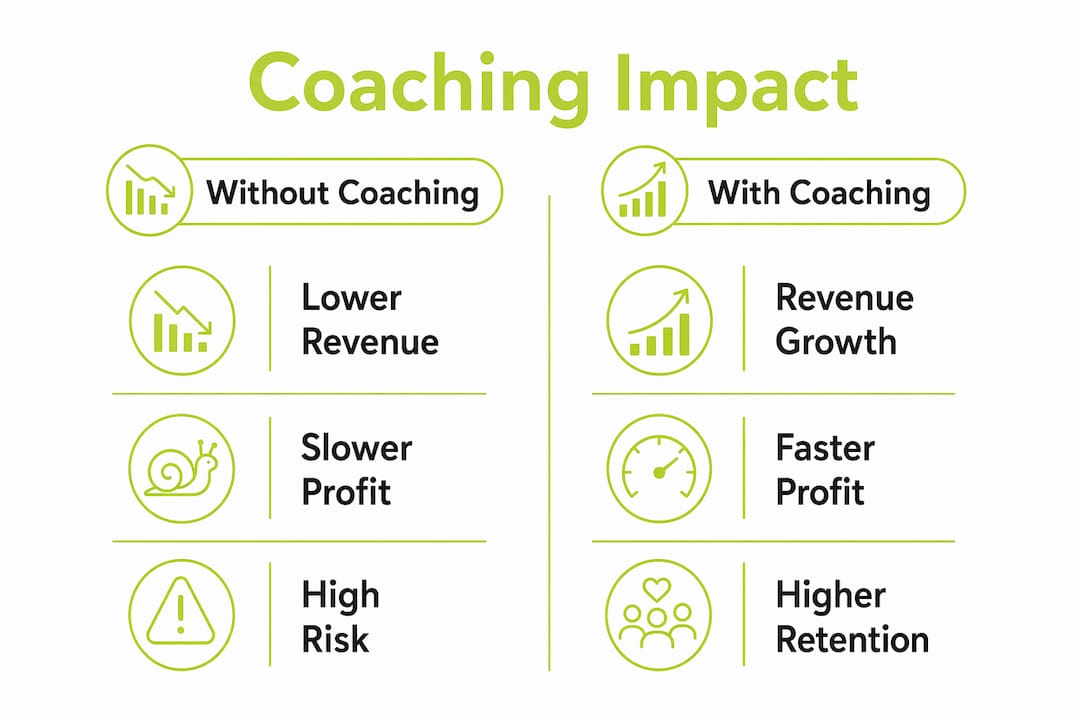
The royalty stream benefit deserves specific attention. Franchisors earn royalties as a percentage of revenue. When coaching lifts unit revenue by even 15%, every location in the network contributes more to the franchisor’s top line without adding a single new location. Coaching is one of the few investments that pays both the franchisee and the franchisor simultaneously.
What coaching models scale franchise development effectively?
Franchise networks face a practical problem: one coach cannot give every franchisee the same depth of attention as the network grows. The solution is a tiered coaching model that matches delivery format to franchisee need and network size.

Group coaching works well for networks with 20 or more locations. Monthly group calls covering shared challenges, brand updates, and peer accountability create a community effect that individual coaching cannot replicate. Franchisees learn from each other’s mistakes, which reduces the cost of trial and error across the network.
Individual coaching remains the gold standard for new franchisees in their first year and for underperforming locations at any stage. The depth of a one-on-one session allows coaches to address location-specific issues that group formats cannot reach.
Technology closes the gap between these two models. Automated engagement platforms cost around $249 per month per seat and replace administrative roles that would otherwise consume a coach’s time. That cost is a fraction of a full-time admin salary, and the consistency these tools deliver is better than any human scheduler.
Automated milestone tracking: Sends reminders for key operational checkpoints without manual follow-up
Session scheduling tools: Reduce no-shows and keep coaching cadence consistent across large networks
KPI dashboards: Give coaches real-time visibility into franchisee performance before each call
Curriculum libraries: Standardize training content so every franchisee gets the same foundational knowledge
Pro Tip: Automated texting tools can schedule, remind, and promote coaching sessions without adding headcount. If your network has more than 10 locations, automate your session reminders before you hire another coordinator.
The ROI math on coaching technology is straightforward. A platform at $249 per month per seat costs less than $3,000 per year. If it keeps one franchisee engaged long enough to hit profitability three months earlier, the royalty revenue generated far exceeds the platform cost.
How can franchisees get more from their coaching relationship?
The single biggest mistake franchisees make with coaching is treating it as a compliance check. Owners who show up to coaching calls prepared to defend their numbers get far less value than owners who show up ready to question their assumptions.
Effective coaching focuses on decision quality, not motivational pep talks. The best coaches help you pressure-test a major decision before you make it, not celebrate the decision after the fact. That distinction separates coaching that changes business outcomes from coaching that just feels good in the moment.
Reframe the relationship. See your coach as a strategic partner with no stake in flattering you. Their job is to tell you what you need to hear, not what you want to hear.
Share problems early. High-performing franchisees bring challenges to their coach before those challenges show up in KPIs. Waiting until the numbers are bad costs you weeks of recovery time.
Focus on the critical 20%. Effective coaching targets the 20% of KPIs that drive 80% of revenue. If you are tracking 15 metrics, your coach should help you identify the three that actually move your business.
Use sessions for decisions, not updates. Status updates waste coaching time. Bring the decision you are stuck on and use the session to work through it with someone who has seen the same situation across dozens of locations.
Commit to the cadence. Skipping sessions is the fastest way to lose the compounding benefit of coaching. Consistency matters more than any single breakthrough conversation.
Coaching accelerates growth by helping franchisees shift from operator to leader. That transition is not automatic. It requires deliberate practice, and coaching is the structure that makes the practice stick.
Key Takeaways
Franchise coaching delivers measurable revenue growth, faster profitability, and higher retention when owners treat it as a strategic partnership rather than a compliance requirement.
PointDetailsCritical early windowThe first 90–180 days of operations set long-term profitability and require active coaching involvement.Quantifiable financial gainsStructured coaching lifts unit revenue by 15–20% and speeds profitability by 3–6 months.Technology scales coachingAutomated platforms at around $249 per month per seat keep large networks consistent without adding headcount.KPI focus drives resultsCoaching works best when it targets the 20% of metrics driving 80% of revenue.Decision quality over motivationThe best coaching improves how owners make decisions, not just how they feel about their business.
Why franchise coaching is the multiplier most owners underestimate
I have spent over two decades watching franchise owners succeed and struggle, and the pattern is consistent. The owners who grow fastest are not the ones with the best locations or the biggest marketing budgets. They are the ones who treat their coach as the most valuable person in their business network.
What surprises most new franchisees is how much of coaching is about slowing down, not speeding up. The instinct when revenue is flat is to add more tactics: more promotions, more staff, more hours. A good coach stops that reflex and asks which of the current tactics is actually working. That question alone saves owners months of wasted effort.
The trend I am watching closely in 2026 is the integration of real-time data into coaching sessions. Coaches who walk into a call with live KPI data from the past seven days have a fundamentally different conversation than coaches working from last month’s report. The gap between what happened and what the owner remembers happening shrinks to zero. That accuracy changes the quality of every decision that follows.
The franchisees who resist coaching the longest are usually the ones who need it most. They see it as oversight. The shift happens when they realize their coach has seen their exact problem play out in 30 other locations and already knows three ways to fix it. That moment, when a franchisee stops defending their approach and starts asking better questions, is when the real growth begins.
— Colby
How Frangelic supports franchise owners through structured coaching
Franchise owners who want a coaching system built around real revenue growth, not generic advice, have a clear option.
Frangelic brings over 20 years of franchising and marketing experience to a structured growth system that combines personalized coaching with proven marketing strategies. The approach gives owners a defined plan to follow, reducing dependence on franchisor support teams and building the confidence to make faster, better decisions. Frangelic’s system is designed for owners who are serious about hitting revenue targets, not just maintaining the status quo. If you are ready to move from reactive management to deliberate growth, a consultation with Frangelic is the logical next step.
FAQ
What is franchise coaching?
Franchise coaching is a structured support system where trained coaches guide franchise owners through operational challenges, performance monitoring, and strategic decision-making to improve profitability and brand consistency.
How much does franchise business coaching cost?
Structured coaching programs typically start around $1,600 per month, with some programs offering performance guarantees tied to profit goals within a defined timeframe.
When should a franchisee start working with a coach?
The first 90 to 180 days of operations are the most critical period for coaching involvement, as early support directly impacts long-term profitability and operational habits.
What is the difference between a franchise coach and a franchise consultant?
A franchise coach provides ongoing accountability, performance monitoring, and decision support throughout the life of the business. A franchise consultant typically advises on the initial purchase or setup process and then steps back.
How does franchise mindset coaching differ from operational coaching?
Franchise mindset coaching focuses on shifting how an owner thinks about their role, moving from day-to-day operator to strategic leader. Operational coaching addresses specific process and performance gaps. The most effective programs combine both.