
The Franchise Marketing Playbook for Franchisors
A franchise marketing playbook works only when it manages two parallel streams at once: franchise development (owner recruitment) and local store marketing (consumer demand). Without that dual-track structure, you get brand drift at the unit level and inconsistent sales performance across the system. The playbook must define who owns each decision, hand franchisees a ready-to-use local toolkit, sequence a 90-day launch, and tie every activation to unit-level KPIs. Here is the compact checklist to start with:
Playbook Mini-Checklist
- Governance module: Assign decision rights, approval SLAs, and escalation paths. Owner: VP Marketing. Target: Week 2.
- Local toolkit: Publish editable templates, approved imagery, copy blocks, and social packages. Owner: Creative Director. Target: Week 4.
- 90-day launch plan: Sequence listings, first campaign, training, and reporting setup. Owner: Franchise Operations. Target: Week 6.
- KPI dashboard: Define cost per qualified lead, local ROAS, and review velocity. Owner: Analytics Lead. Target: Week 8.
- Compliance and crisis protocol: Document brand standards and escalation contacts. Owner: Legal/Brand. Target: Week 10.
Three actions you can assign today: (1) Audit which decision rights are currently undocumented. (2) Identify the three highest-traffic local channels for your top-performing unit. (3) Schedule a 30-minute kickoff with your analytics lead to define unit-level KPIs.
Key Takeaways
A franchise marketing playbook delivers measurable local growth only when it pairs a hybrid governance model with a complete local toolkit, a sequenced 90-day launch, and unit-level KPIs tied to real revenue outcomes.
| Point | Details |
|---|---|
| Separate the two marketing streams | Franchise development and local consumer marketing need distinct strategies, budgets, and assets. |
| Set a 48-hour approval SLA | Document it formally so franchisees submit faster and corporate teams prioritize reviews. |
| Reinvest more than a significant portion locally | Brands reinvesting more than a notable portion of monthly revenue in local marketing commonly see same-store sales gains. |
| Launch the 90-day onboarding plan first | New locations that follow a sequenced plan reach first revenue milestones faster than ad hoc launches. |
| Frangelic builds the full system | Frangelic delivers the governance, toolkit, coaching, and CRM integration to make the playbook operational. |
What does a franchise marketing playbook actually cover?
A franchise marketing playbook is the governing document that defines strategy, standards, assets, workflows, and metrics for marketing across every unit in a system. Think of it as the operating manual your corporate team and franchisees both reach for when a campaign needs to launch or a brand decision needs to be made.
ARC4’s franchise marketing framework draws a clear line between the two streams every playbook must manage. Franchise development marketing targets prospective owners: paid search, trade shows, referral programs, and FDD-compliant lead nurturing. Local store marketing targets consumers in a specific trade area: Google Business Profile, local social, direct mail, and geo-targeted digital ads. Conflating the two produces muddled messaging and wasted budget.
| Responsibility | Corporate (Franchisor) | Franchisee |
|---|---|---|
| Brand standards and creative approval | Owns | Follows |
| National media buying | Owns | Contributes via ad fund |
| Local campaign execution | Provides templates | Activates and funds |
| Google Business Profile management | Sets standards | Manages daily |
| Budget allocation guidance | Defines ranges | Decides within range |
| Reporting and data access | Aggregates system-wide | Submits unit data |
Core playbook modules every franchisor must include
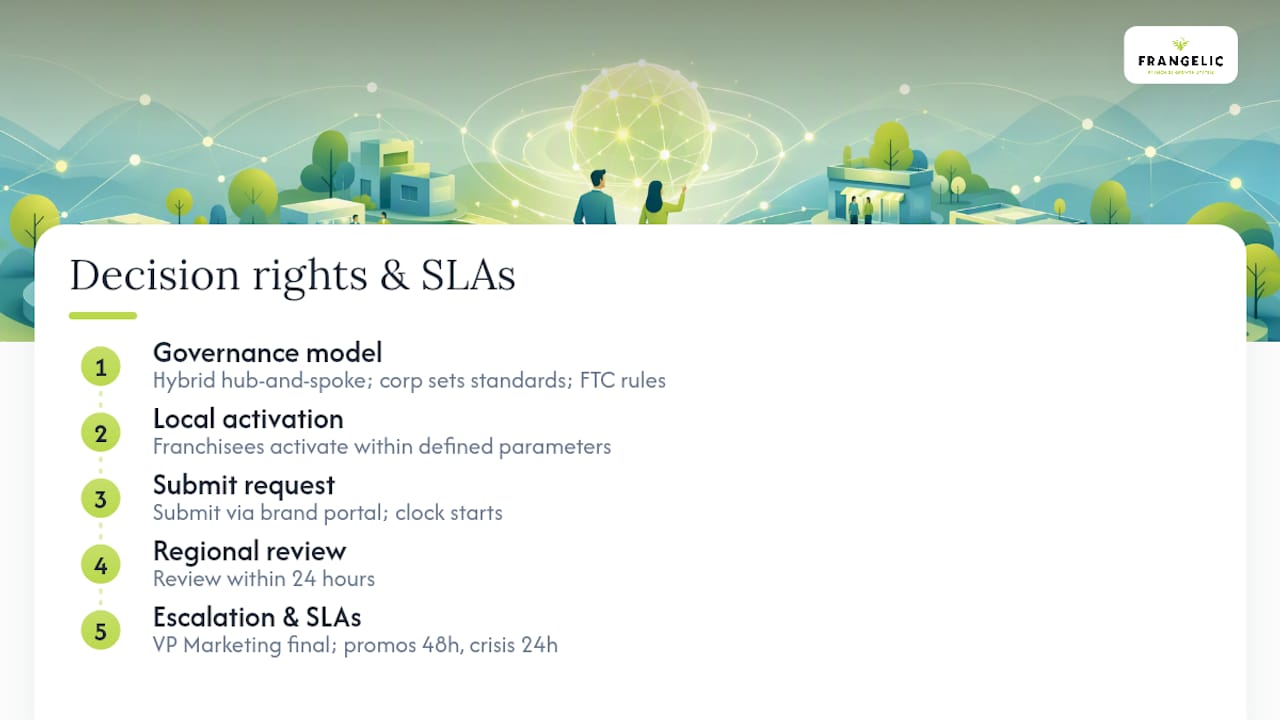
The essential modules are governance, local toolkit, campaign workflows, measurement, onboarding, compliance, and crisis communications. Skipping any one of them creates a gap a franchisee will fill on their own, usually inconsistently.
1851 Franchise’s guidance on sustainable growth makes the sequencing argument clearly: fix internal capacity and operational readiness before scaling unit count. That principle applies directly to playbook development. Build the support infrastructure first.
- Governance module: Decision matrix, approval SLAs, escalation contacts. Owner: VP Marketing.
- Local toolkit: Templates, asset library, naming conventions, distribution system. Owner: Creative Director.
- Campaign workflows: Brief-to-launch checklist, UTM standards, channel playbooks. Owner: Digital Marketing Manager.
- Measurement framework: KPI definitions, dashboard templates, reporting cadence. Owner: Analytics Lead.
- 90-day onboarding plan: Launch sequence for new locations. Owner: Franchise Operations.
- Compliance and legal: Brand standards, FTC disclosure alignment, enforcement process. Owner: Legal/Brand.
- Crisis communications: Response protocols, escalation tree, pre-approved messaging. Owner: PR/Brand.
Prioritize by maturity. A brand under 50 units should nail governance and the local toolkit first. Systems above 100 units typically need campaign workflows and measurement infrastructure before anything else pays off.
How should you structure decision rights across the system?
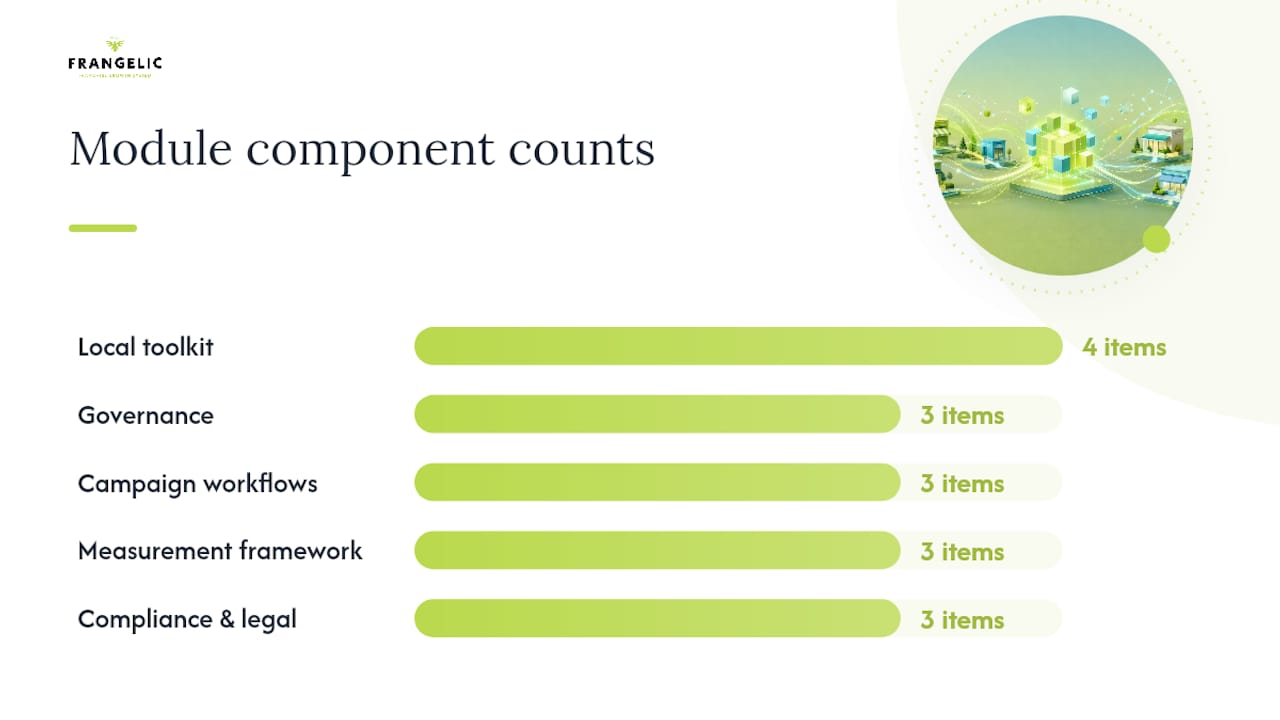
The most effective governance model is a hybrid hub-and-spoke: corporate owns brand standards, national creative, and media strategy; franchisees activate locally within defined parameters. A flat centralized model kills local relevance; a fully decentralized one destroys brand equity. The hybrid documented in a decision matrix is the practical middle ground.
Strategus notes that channels like CTV let franchisors preserve national creative and measurement standards while franchisees run household-level or trade-area targeting within the same buying system. That is the hybrid model in action at the media level.
Approval SLAs matter as much as the matrix itself. A franchisee running a time-sensitive local promotion cannot wait five business days for creative sign-off. Set a 48-hour SLA for local promotional assets and a 24-hour SLA for urgent crisis-related content. Document the escalation path: franchisee submits via brand portal, regional manager reviews within 24 hours, VP Marketing is the final escalation for anything outside brand standards.
The FTC’s consumer guide for franchises outlines disclosure obligations that shape how franchisors communicate marketing requirements to franchisees. Compliance with those standards belongs in the governance module, not as a footnote.
Pro Tip: Set a hard 48-hour approval SLA for local promotional assets and publish it in the franchise agreement supplement. Franchisees who know the clock starts when they submit stop sitting on requests, and corporate teams stop treating approvals as low-priority tasks.
What goes into a local marketing toolkit?
The local toolkit is the asset package franchisees open when they need to run a campaign without calling corporate. It must be complete enough to use without customization, yet flexible enough to localize. Must-have assets include:
- Editable creative templates (social, display, print) in Canva or Adobe Express formats
- Approved photography and short-form video by category (food, service, seasonal)
- Copy blocks for common offers, seasonal promotions, and grand openings
- Local offer templates with approved price-range fields
- Social post packages (captions, hashtags, image sets) for 30-day content calendars
- Email flows for new customer welcome and re-engagement sequences
- Google Business Profile templates (description, post formats, review response scripts)
- Multi-location SEO templates for location pages
Asset naming convention example: [Brand]_[Channel]_[Format]_[Season/Offer]_[Version]
Example: BrandX_Social_1080x1080_SummerPromo_v2.png
Distribute assets through a brand portal or digital asset management (DAM) system. Google Drive works for small systems; platforms like Bynder or Brandfolder scale better above 50 units. Set clear rules: franchisees may swap approved images and localize copy within defined fields. They may not alter logos, change brand colors, or create net-new creative without approval. Governance rules for local social media management should specify who posts, who moderates, and what requires pre-approval.
How do you run a campaign from brief to launch?
A short, repeatable workflow prevents the most common failure mode in franchise marketing: campaigns that launch late, track nothing, and produce no learnings. The sequence is brief, build, approve, launch, measure, optimize.
- Brief (Day 1): Define objective, audience, geography, offer, budget, and success metric. Franchisee or regional manager completes a one-page brief template.
- Build (Days 2–4): Pull assets from the toolkit. Select channels. Set up UTM parameters using the system naming standard.
- Approve (Days 5–6): Submit via brand portal. Regional manager reviews creative compliance. VP Marketing approves anything outside standard parameters.
- Launch (Day 7): Activate paid channels, publish organic content, confirm tracking is live.
- Measure (Days 8–14): Pull weekly report against KPIs. Flag underperformers by Day 10.
- Optimize (Day 14+): Reallocate budget to top-performing placements. Document learnings in the campaign log.
UTM naming standard example: utm_source=facebook&utm_medium=paid_social&utm_campaign=BrandX_Local_SummerPromo_[LocationID]&utm_content=1080x1080_OfferA
Consistent UTM tagging is the single most important attribution habit in a multi-location system. Without it, you cannot separate a Miami unit’s performance from a Denver unit’s in the same campaign. Assign one person per region to audit UTM compliance weekly for the first 90 days.
Which KPIs actually predict unit profitability?
Measure outcomes, not activity. Impressions and follower counts tell you nothing about whether a unit is growing. The metrics that predict profitability are cost per qualified lead, in-store visit or booking rate, and local return on ad spend (ROAS).
The IFA-hosted Scorpion franchise marketing playbook reports that brands reinvesting more than 5% of monthly revenue in local marketing commonly see improved same-store sales. That benchmark gives you a floor for budget conversations with franchisees.
| Metric | Definition | Reporting Frequency |
|---|---|---|
| Cost per qualified lead | Ad spend ÷ leads meeting qualification criteria | Weekly |
| Local ROAS | Revenue attributed to local ads ÷ local ad spend | Weekly |
| In-store visit or booking rate | Visits or bookings from tracked local campaigns | Weekly |
| Review velocity | New Google reviews per month per location | Monthly |
| Same-store sales lift | % revenue change vs. prior period, same unit | Monthly |
| Speed to lead | Time from lead submission to first contact | Weekly |
Reporting cadence: weekly data goes to the franchisee and regional manager; monthly rollups go to the regional director; quarterly brand-level aggregates go to the executive team. Franchisees should have read access to their own unit dashboard at all times.
What does a 90-day launch plan look like for a new location?
New locations that follow a sequenced 90-day plan reach their first meaningful revenue milestone faster than those that launch ad hoc. The sequence below is the minimum viable onboarding plan.
Days 0–30: Foundation
- Claim and optimize Google Business Profile with approved description, photos, and hours.
- Set up location pages on the brand website using SEO templates.
- Complete marketing training module (brand standards, toolkit walkthrough, campaign brief process).
- Launch grand opening campaign using pre-built toolkit assets.
- Set up unit dashboard and confirm UTM tracking is live.
Days 31–60: First Campaign Cycle 6. Run first paid local campaign (social + search) with a 30-day budget. 7. Collect first 10 Google reviews using the approved review request script. 8. Complete first weekly KPI report and submit to regional manager. 9. Attend first group coaching session with the regional marketing team.
Days 61–90: Optimize and Sustain 10. Analyze first campaign cycle: identify top channel, top creative, and cost per lead. 11. Reallocate budget based on Week 4–8 performance data. 12. Publish 30-day content calendar for Month 3 using social post packages. 13. Complete compliance check: confirm all active assets meet brand standards.
Peer-to-peer coaching during the 31–60 window accelerates adoption. New franchisees learn faster from operators who have run the same playbook than from a corporate training deck alone.
What does success look like in practice?
Brands that implement a structured playbook consistently report three early wins: faster speed-to-lead, higher review velocity, and measurable same-store sales improvement within the first two quarters. These are the benchmarks worth targeting.
For context on how leading brands are structuring these programs, Scorpion’s release of the franchise marketing playbook through the IFA signals that playbook-driven marketing has become a recognized standard, not an advanced tactic.
Common benchmarks brands use as early targets:
- Review velocity: 8–15 new Google reviews per location per month within the first 90 days
- Speed to lead: First contact within 5 minutes of a digital inquiry submission
- Same-store sales lift: A measurable positive trend by Month 3 when the local toolkit is fully deployed
- Local ROAS: A positive return on local ad spend by the end of the first 60-day campaign cycle
One anonymized example: a 30-unit QSR brand that standardized its local toolkit and launched a 90-day onboarding program saw review velocity increase across new locations and reduced the time its support team spent on ad hoc creative requests. The shift came from giving franchisees pre-approved assets rather than a blank canvas.
How Frangelic implements the playbook across your system
Frangelic operationalizes every module in this playbook through its coaching program, launch kits, scorecards, and CRM integrations. The system is built specifically for franchisors who need to move from a loose collection of brand guidelines to a functioning, measurable marketing operation.
The Frangelic franchise marketing systems guide maps the connection between marketing infrastructure and revenue outcomes at the unit level. The approach draws on over 20 years of franchising and marketing experience, with a focus on reducing franchisor support workload while increasing franchisee confidence and execution speed.
| Playbook Component | Frangelic Deliverable |
|---|---|
| Governance and decision rights | Decision matrix template + approval workflow training |
| Local toolkit | Customizable launch kit with templates, copy blocks, and asset library |
| Campaign workflows | Step-by-step campaign brief and launch checklist |
| Measurement and KPIs | Scorecard templates + CRM dashboard integration |
| 90-day onboarding | Structured launch program with weekly milestones |
| Training and compliance | Live group coaching + brand standards training module |
| Crisis communications | Escalation protocol template + response script library |
Frangelic builds your franchise marketing playbook with you
Franchise leaders who want a playbook built and implemented, not just described, get a concrete starting point with Frangelic’s pilot program. The pilot delivers the full infrastructure in 90 days.
Frangelic’s pilot includes a custom 90-day launch plan for your system, editable local toolkit templates, weekly 1:1 coaching sessions, a KPI scorecard tied to unit-level revenue, and CRM integration support. The result is a marketing operation your franchisees can run without calling corporate for every decision, and a support team that spends less time on reactive requests.
Brands that build the playbook before scaling units grow more sustainably than those that chase territory count first; learn more about franchise financing in Canada to support your growth strategy. If your system is ready to make that shift, start with Frangelic’s franchise growth program and get your first 90-day plan in place.
Sources
The most useful resources for building and validating your playbook are available directly from the IFA and primary regulatory bodies.
- Consumers’ guide to buying a franchise — FTC
- Franchise advertising — Strategus
- Franchise marketing plan — ARC4
- How do I grow my franchise system sustainably? — 1851 Franchise