

Franchise Marketing Systems That Drive Real Growth
Franchise marketing systems are integrated frameworks that connect brand-level governance with location-level execution across every unit in a network. The most effective systems allocate 65–70% of the marketing budget to local store marketing and trade area development. That single budget principle separates high-growth franchise networks from stagnant ones. Tools like Google Business Profile, multi-location social media platforms, and marketing automation are the operational backbone of any system built to scale. Frangelic has spent over 20 years helping franchise owners build exactly this kind of structured, repeatable approach to local marketing.
What foundational tools support franchise marketing systems?
Google Business Profile is the single most critical local SEO asset a franchise owner controls. 60% of customers view Google Business Profiles as the primary influence before calling or visiting a franchise location. That means an incomplete or unmanaged profile directly costs you foot traffic and phone calls.
Multi-location social media management platforms give franchisors the ability to publish brand-approved content while letting individual locations add local flavor. The best platforms include mobile-first interfaces that franchisees can use without logging into a desktop dashboard. This matters because passive login systems produce low adoption rates across the network.

Marketing automation platforms scale personalization by location without requiring a full marketing team at each unit. A franchisee in Austin gets different email sequences and ad triggers than one in Minneapolis, based on local demand signals. That kind of territory-level targeting is impossible to run manually across 50 or 100 locations.
Paid search tools with dynamic budget reallocation round out the core toolkit. These systems shift ad spend toward locations with higher local search volume in real time, without requiring manual intervention from the franchisee.
Core tools every franchise marketing system needs:
Google Business Profile: Manages local SEO, reviews, and map visibility for each location
Multi-location social media platform: Publishes brand content with local customization options
Marketing automation platform: Delivers location-specific email, SMS, and ad sequences
Territory-level paid search: Adjusts budgets based on local search volume and cost data
Co-op fund management tool: Tracks franchisee contributions and spend in one place
Tool CategoryPrimary FunctionKey BenefitGoogle Business ProfileLocal SEO and map presenceDrives foot traffic and callsSocial media managementBrand-consistent local postingHigher franchisee activationMarketing automationLocation-specific campaignsScales without extra headcountPaid search managementTerritory-level ad spendImproves local ROASCo-op fund trackingBudget transparencyReduces franchisor-franchisee friction
Pro Tip: Audit every location’s Google Business Profile quarterly. Check for missing hours, outdated photos, and unanswered reviews. These small gaps compound into significant lost revenue across a large network.
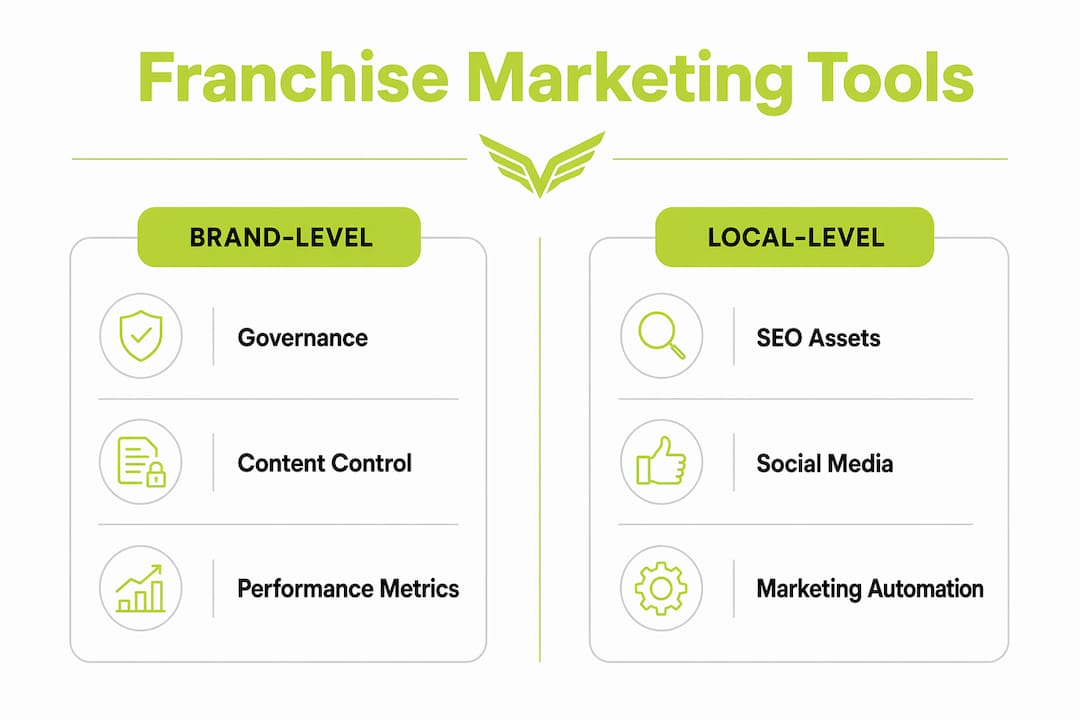
How to design franchise marketing workflows for local store success
The hub-and-spoke model is the standard operational framework for franchise social media. Hub-and-spoke workflows enforce brand compliance through strict rules on promotions and pricing while allowing franchisees to post positive local content. The franchisor acts as the hub, setting templates and guardrails. Each franchisee location is a spoke, executing within those boundaries.
Setting up this workflow requires four clear decisions before you launch anything.
Define permission levels. Decide which content categories franchisees can create independently, which require approval, and which are franchisor-only. Promotions and pricing always stay at the hub level. Local community posts and customer spotlights can go to franchisees.
Build a co-op fund playbook. A shared co-op fund playbook with simple approval workflows keeps franchisee spend consistent and amplifies collective marketing impact. Every franchisee should know exactly how much they contribute, how funds are spent, and what results those funds produced.
Run a structured 90-day onboarding program. A 90-day onboarding program with webinars and automated nudges increases franchisee marketing system adoption significantly. Week one covers platform access and profile setup. Weeks two through four focus on the first live campaign. Months two and three build the habit of regular posting and review management.
Set content guardrails in writing. Franchisees need a one-page reference that tells them what they can post, what they cannot post, and how to get approval for edge cases. Ambiguity creates brand compliance problems. Clarity creates confidence.
Automate the nudges. Franchisees who go quiet on social media or stop logging into the marketing platform need automated reminders, not manual calls from the support team. Set trigger-based emails at 7, 14, and 30 days of inactivity.
Pro Tip: Create a “local content library” inside your social media platform with 20 to 30 pre-approved post templates that franchisees can personalize with their location name and a local photo. This removes the blank-page problem that stops most franchisees from posting.
What are best practices for local marketing budget allocation?
The 65–70% local allocation rule is the starting point, not the finish line. The remainder of the budget funds national brand awareness, which creates the rising tide that lifts all locations. Getting this split right requires quarterly reviews, not annual ones.
Quarterly budget rebalancing using local search volume data can improve local paid search ROAS by 18–35% without increasing total ad spend. That improvement comes entirely from moving money to where demand already exists. A location in a high-growth suburb may need three times the paid search budget of a mature urban location, even if both units are the same size.
Integrating paid search, social ads, and review management creates compounding returns at the local level. A customer who sees a paid search ad, clicks through to a Google Business Profile with 200 five-star reviews, and then sees a retargeting ad on social media converts at a much higher rate than one who encounters only a single channel. The system creates multiple touchpoints without requiring the franchisee to manage each one manually.
Budget allocation priorities for local franchise marketing:
Allocate 65–70% of total marketing spend to local store marketing and trade area campaigns
Reserve 15–20% for national brand awareness and co-op fund contributions
Use 10–15% for testing new channels, seasonal promotions, and local sponsorships
Review local search volume data every quarter and shift paid search budgets accordingly
Track cost per qualified lead and local ROAS as the primary efficiency metrics
Multi-location SEO requires a unique identity per location to avoid duplicate content and ranking cannibalization. Each location page on the brand website needs a unique address, phone number, local staff photo, and location-specific copy. Generic copy pasted across 50 location pages actively hurts search rankings for every unit.
How do you measure franchise marketing system performance?
Measurement works at three levels: location, regional, and brand. Each level needs its own metrics and its own reporting cadence. Mixing them into one report creates noise that obscures what actually needs attention.
Real-time proprietary reporting enables franchisor monthly reviews that keep franchisees aligned with brand marketing goals. Monthly reviews catch problems before they become patterns. Weekly check-ins at the location level catch execution gaps before they affect monthly numbers.
The metrics that matter most at each level:
Location level: Cost per qualified lead, review count and average rating, local ROAS, social media engagement rate
Regional level: Aggregate lead volume by territory, budget utilization rate, franchisee activation percentage
Brand level: Total marketing spend efficiency, year-over-year location revenue growth, net promoter score trends
Centralized reporting dashboards motivate franchisees by creating transparent performance comparisons among locations. When a franchisee sees that a similar location in another city generates twice the leads at the same cost, they ask what that location is doing differently. That curiosity drives adoption far more effectively than mandates.
Franchise marketing growth correlates directly to systems that balance centralized governance with franchisee empowerment through connected platforms. The measurement system is where that balance becomes visible. Franchisees who see their own data, understand how it compares to peers, and know exactly what to do next are the ones who grow.
Pro Tip: Build a “franchisee activation dashboard” that shows, in real time, which locations are running active campaigns, which have posted on social media in the last 7 days, and which have responded to recent reviews. This single view tells you where to focus your support effort each week.
Key Takeaways
Effective franchise marketing systems require the right tools, clear workflows, disciplined budget allocation, and consistent measurement at every level of the network.
PointDetailsPrioritize local budget allocationDirect 65–70% of marketing spend to local store marketing for maximum growth impact.Use Google Business Profile activelyManage every location’s profile to capture the majority of customers who research before visiting.Build hub-and-spoke workflowsSet brand guardrails at the center and give franchisees structured freedom at the location level.Run quarterly budget rebalancingUse local search volume data to shift paid search spend and improve ROAS without extra cost.Measure at three levelsTrack location, regional, and brand metrics separately to catch problems early and reward top performers.
The real challenge is adoption, not technology
The tools for franchise marketing are better than they have ever been. The actual bottleneck is getting franchisees to use them consistently. I have seen networks invest in excellent platforms and watch adoption stall at 30% because nobody built a real onboarding program or created accountability around participation.
The franchisees who struggle most are not the ones who lack motivation. They are the ones who lack clarity. They do not know which tasks to prioritize, how to read their own performance data, or what good looks like for their territory. That uncertainty leads to inaction, and inaction looks like disengagement from the outside.
Mobile-first AI-assisted social posting combined with activation campaigns produces franchisee engagement rates of 75–80%, compared to much lower rates from passive login systems. That gap exists because the best systems reduce the decision burden on the franchisee. They do not ask the owner to figure out what to post. They present a ready-to-publish post and ask for one tap of approval.
The franchisor’s job is not to control every marketing decision. It is to make the right decision the easiest one. When the system is built that way, compliance becomes a byproduct of convenience rather than a source of conflict. That shift changes the entire relationship between franchisor and franchisee.
— Colby
How Frangelic supports your franchise marketing operations
Franchise owners who want real traction from their local marketing need more than a platform. They need a system with clear priorities, recurring accountability, and someone who has done this before.
Frangelic combines over 20 years of franchising and marketing experience into a structured growth system built specifically for franchise owners. The Frangelic Franchise Growth System gives owners real-time campaign visibility, recurring performance reviews, and practical guidance on co-op fund management and franchisee activation. The goal is straightforward: fewer support calls, stronger revenue, and a network that grows with momentum instead of friction. Franchise owners who work with Frangelic gain the clarity to make confident marketing decisions without depending on a support team for every next step.
FAQ
What are franchise marketing systems?
Franchise marketing systems are integrated frameworks that connect brand-level governance with location-level marketing execution. They include tools, workflows, budget structures, and reporting processes that help franchise networks grow consistently.
How much should a franchise spend on local marketing?
Industry guidance for 2026 recommends allocating 65–70% of the total marketing budget to local store marketing and trade area development. The remainder supports national brand awareness and co-op fund contributions.
Why is Google Business Profile critical for franchise marketing?
60% of customers view Google Business Profiles as the primary influence before calling or visiting a franchise location. An incomplete or poorly managed profile directly reduces foot traffic and inbound calls.
What is the hub-and-spoke model in franchise social media?
The hub-and-spoke model places the franchisor at the center to set brand rules and templates, while each franchisee location posts local content within those guardrails. It enforces brand compliance without removing all local flexibility.
How do you increase franchisee marketing adoption?
A structured 90-day onboarding program with webinars and automated nudges significantly increases adoption. Mobile-first platforms with AI-assisted posting also produce franchisee activation rates of 75–80%, far above passive login systems.