
Franchise Sales Handoff: Operations First Checklist in 48 Hours
A successful franchise sales handoff hands the new owner a launch-ready unit, not just a signed contract. That means an assigned onboarding coach, a delivered welcome package, and a clear phased timeline within a few days of signing. Skip that window and you’re already managing confusion instead of momentum.
TL;DR:
- A clear franchise handoff should occur within days of signing, including a welcome package and a dedicated onboarding coach to prevent confusion.
- The transfer process must be divided into four phases: preparation, training and immersion, soft opening, and stabilization, with specific deliverables at each step.
- Deliverables such as signed documents, training completion, and marketing support are milestones that protect long-term unit profitability during the first six months.
- Effective tracking tools like project boards, LMS, and scorecards help ensure tasks stay on schedule and flag issues early for intervention.
- Regular check-ins and real-time data monitoring are essential to measure progress, escalate problems promptly, and maintain unit support through initial months.
Why the Franchise Sales Handoff Process Needs Distinct Phases
Franchisors who treat onboarding as one long blur lose franchisees to confusion before they ever open. The fix is breaking the franchise transfer process into four distinct phases, each with its own owner and deliverables.
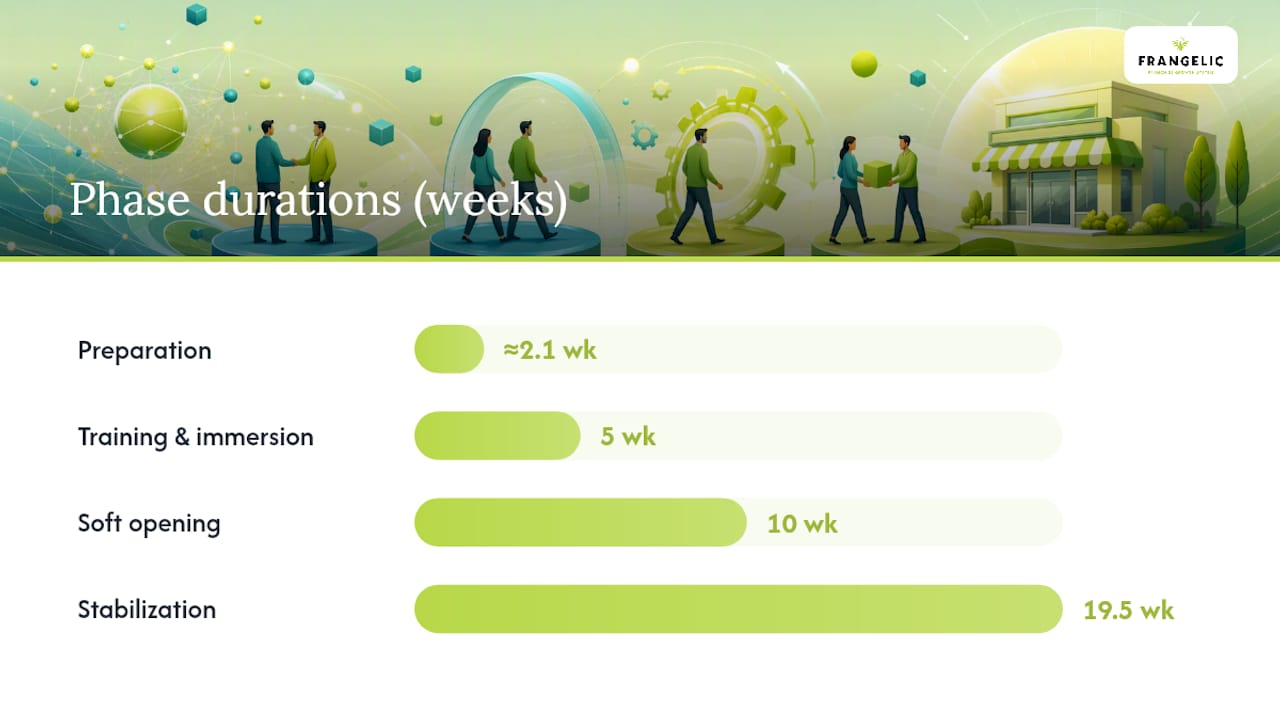
Preparation (Days 0 to 30): This is where legal, financial, and administrative groundwork gets laid before any real training starts. Franchise.family recommends a foundation stage in the first two weeks that mirrors this same logic, front loading the paperwork so training time isn’t wasted on logistics.
Training and immersion (Weeks 2 to 8): Core skills, systems, and brand standards get taught here, ideally split between virtual modules and in-person practice. This window covers the bulk of the franchise sales training curriculum through which most brands run new owners.
Soft opening (Weeks 8 to 12): The unit opens with reduced hours or a limited menu of services, giving staff and systems a chance to fail small before they fail big.
Stabilization (Months 3 to 6): Support shifts from intensive coaching to periodic check-ins as the franchisee builds independent judgment.
Franchisor deliverables at each phase include:
- Signed disclosure documents, entity paperwork, and approved site plans (preparation)
- Completed training modules, certification sign-off, and a staffed opening team (training)
- Grand opening marketing support and daily performance monitoring (soft opening)
- A documented transition to standard field support cadence (stabilization)
The 90-day and 6-month checkpoints matter because they’re where franchisors set nonnegotiable milestones that protect long-term unit economics, not just launch-day optics.
What Goes on the Franchise Handoff Checklist?
A welcome package delivered shortly after signing does more than look organized. It measurably improves franchisee confidence and cuts down on the panicked phone calls that eat up support team hours in week one.
The package itself should include:
- The operations manual, tabbed by function, not buried as one giant PDF
- A contact sheet naming every department head and the onboarding coach directly
- A written onboarding roadmap with dates, not just phase names
- Approved vendor and supplier lists with account setup instructions
- LMS login credentials and a training completion deadline
Immediate administrative tasks need owners and deadlines, not just a mention in an email thread. Responsibilities for these tasks and expected timelines should be clearly assigned, avoiding vague terms like “the corporate team.”
Assign a single name to each line item. “The corporate team” is not an owner. When two departments think the other is handling entity setup, it doesn’t get handled at all.
How Should Franchisee Training Be Structured?
Split training by what it actually requires. Knowledge transfer, like brand history, financial systems, and compliance policy, works fine over video. Skills that require muscle memory, reading a customer’s body language, running the equipment, closing a sale in person, need a human in the room. The International Franchise Association points to this hybrid split as a way to cut travel costs while keeping in-person time focused on what actually moves performance.
Sequence it with the Know, Show, Do, Review method:
- Know — the franchisee studies the material (virtual, self-paced)
- Show — a trainer demonstrates the task live or on video
- Do — the franchisee performs it under supervision
- Review — the coach debriefs what worked and what didn’t
Repeat that loop for every core competency instead of front loading a week of lectures and hoping it sticks.
The onboarding coach is the person who makes this loop function. They run weekly check-ins, coordinate between marketing, operations, and training departments, and stay the single point of contact through the transition to standard field support. Field visits and role-specific simulations, like a mock sales call or a live customer rush, should land toward the end of the immersion window, once the franchisee has enough foundation to actually absorb the feedback.
Pro Tip: Schedule the first field visit partway through training rather than immediately, not week 1. A coach walking the floor too early just adds noise; by week 6, the franchisee has specific questions worth answering in person.
What Tools Keep an Onboarding Handoff on Track?
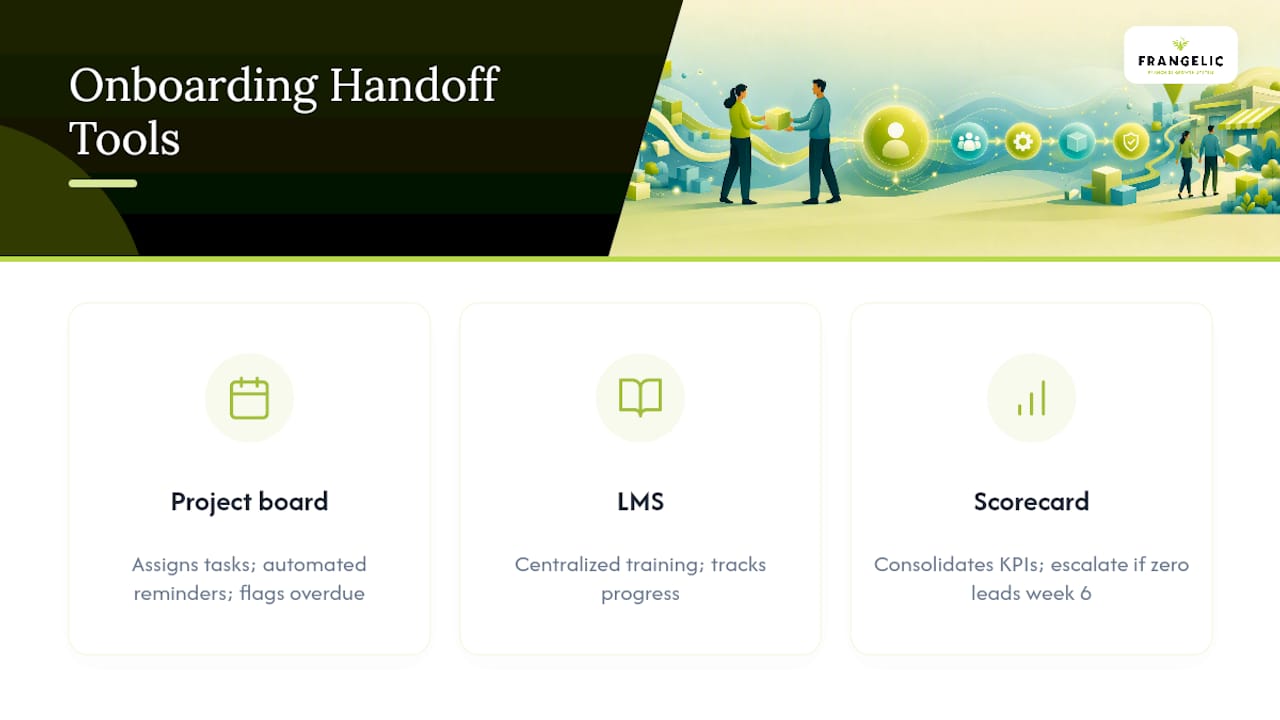
A centralized tracker is what separates an onboarding process that runs itself from one that depends on someone remembering to send a follow-up email. Franchisors using a project board style tool, the kind of workflow monday.com popularized in franchise operations, get automated reminders and a live view of exactly which units are on pace and which are stalling.
Key tools include onboarding trackers or project boards that assign tasks and flag overdue items, learning management systems (LMS) for centralized training and tracking progress, and scorecard dashboards that consolidate key performance data.
This kind of centralized tracking cuts support workload while giving leadership an early warning system for units that need intervention before the 90-day mark. When a franchisee’s scorecard shows zero local leads generated by week 6, that’s your escalation trigger, not a wait-and-see situation.
How Do You Measure Whether the Handoff Worked?
Regular check-ins through the first few months help prevent small problems from escalating. This isn’t excessive hand holding. Franchising.com frames the entire window between signing and stability as an intensive-care phase that determines whether a unit protects or erodes long-term enterprise value.
Track quantitative metrics like training completion and sales benchmarks along with qualitative indicators such as customer feedback and staffing stability during initial months.
When a milestone gets missed, escalate immediately: add coaching hours, deploy temporary field support, or run a targeted marketing push through the franchisee’s local channels. And don’t let onboarding data die in a spreadsheet. Franchisors who document real ramp timelines and stabilization rates gain a genuine recruitment advantage when the next candidate asks how fast units actually get profitable.
Why Franchisors Choose Frangelic for Franchise Onboarding Support
The Growth System addresses the gap most brands hit after signing: a franchisee who has the paperwork but not the plan. That’s a different problem than legal transfer, and it needs a different fix.
The Growth System maps directly onto handoff needs: structured onboarding coaching, a franchisee coaching plan built around your brand’s specific ramp timeline, launch and grand-opening plans, and scorecards that track the same KPIs your onboarding coach should already be watching. Franchisors get a system that can be handed off consistently, instead of reinventing onboarding with every new signature. If your current process runs on tribal knowledge and good intentions, request a consultation or ask for a sample onboarding checklist to see how the Growth System slots into your existing timeline.
Primary Sources and Further Reading
The International Franchise Association’s guide to world-class onboarding covers the three-phase model and tracking tools referenced throughout this article. Franchising.com’s piece on onboarding as the critical phase makes the enterprise-value case for milestone discipline. FMS Franchise’s onboarding process guide breaks down welcome packages and the single-coach model in practical detail.
Sources
- Beyond the Franchise Agreement: Building A World-Class Onboarding and Support System - International Franchise Association
- From signing to stability: Onboarding is the most critical phase in franchise growth
- Franchisee Onboarding Process That Drives Success
FAQ
What Is a Franchise Sales Handoff?
It’s the structured transfer of responsibilities, training, and operational knowledge from the franchisor to a new franchisee after the agreement is signed, covering everything from the welcome package to the first stable months of operation.
How Long Should Franchise Onboarding Take?
Most structured programs run from signing through six months of stabilization, with intensive support in the first 90 days and check-ins tapering after that.
Who Should Be the Single Point of Contact During Handoff?
A dedicated onboarding coach, someone who coordinates across training, marketing, and operations and stays with the franchisee through the transition to standard field support.
What Belongs in a Franchise Welcome Package?
An operations manual, a contact sheet, a dated onboarding roadmap, vendor lists, and LMS credentials, delivered within 24 to 48 hours of signing.
How Does Frangelic Support Franchise Onboarding?
Frangelic’s Growth System pairs onboarding coaching with launch plans and scorecards built around a brand’s own ramp timeline, giving franchisors a repeatable structure instead of an improvised one.