
Operational Playbook for Franchisors: Turn Town Halls Into 30 Day Results
A franchise town hall exists to convert corporate strategy into franchisee action, measured by specific numbers. The winning structure is simple: two or three SMART objectives, a facilitator who can manage the room, formats that force decisions instead of just information dumps, and a follow-up plan published within 72 hours. Success looks like measurable owner behavior change inside 30 days, not applause in the room.
TL;DR:
- Franchise town halls should have two to three specific, measurable goals aligned with actionable outcomes, not vague objectives like morale boosting.
- Using targeted breakout formats with assigned owners and deadlines increases the likelihood of behavior change and initiative adoption post-meeting.
- Effective facilitation with clear rules, pre-submitted questions, and escalation paths prevents venting and ensures constructive discussion.
- Hybrid meetings require robust technology such as live polling, anonymous Q&A, recording, captioning, and integration with CRM systems to track commitments.
- Success depends on publishing an action plan within 72 hours, establishing 30 and 90-day checkpoints, and consistently following up to turn meeting output into accountable results.
Planning a Franchise Town Hall Before the Meeting Starts
Most franchise town halls fail before anyone books a room. They fail at the planning stage, when a corporate team decides the meeting is “an update” instead of a decision engine with a target.
Start by setting two to three SMART objectives tied to a measurable outcome, such as significant adoption of a new marketing program within a few months of the meeting. Vague goals like “align the system” or “boost morale” cannot be scored later, which means nobody will ever know if the meeting worked.
Once the objectives are locked, segment your audience. New franchisees, multi-unit operators, and underperforming locations do not need identical content, and running one generic session for all of them wastes the room’s time. Build tracks or clearly signaled breakout paths so a multi-unit operator isn’t sitting through onboarding basics.
Before you finalize the agenda, collect real input from the system. Corporate Optics recommends gathering franchisee input alongside SMART goal setting, and pulse surveys, pre-event AMAs, and short one-on-one interviews all surface what franchisees actually want addressed, which is often different from what corporate assumes.
Logistics deserve a checklist of their own:
- Confirm timing that works across time zones if the system is hybrid
- Test AV and hybrid connectivity days in advance, not the morning of
- Finalize materials, handouts, and slide decks a week out
- Assign a clear executive role for opening remarks and closing commitments to ensure accountability
Pro Tip: Run your pulse survey two weeks out, not two days out. You need time to actually change the agenda based on what franchisees tell you, not just time to read the results.
Building an Agenda and Formats That Drive Real Engagement
A 90-minute virtual session and a half-day in-person event need different architecture, but both should open with a clear goal statement and close with named commitments.
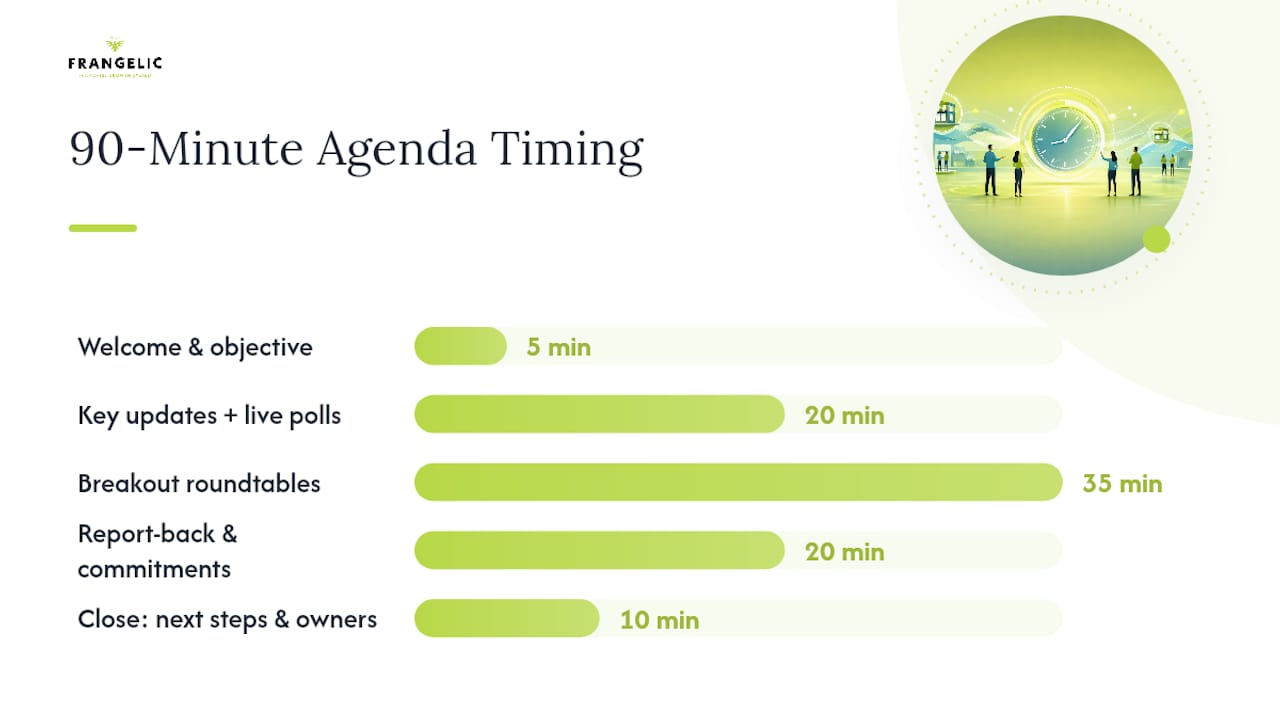
Sample 90-minute agenda:
- Welcome and objective statement (5 minutes)
- Key updates with live polling checkpoints (20 minutes)
- Breakout roundtables on one priority topic (35 minutes)
- Report-back and commitment capture (20 minutes)
- Close with next steps and owners (10 minutes)
A half-day format simply expands step three into two or three rotating breakout blocks, often using a World Café structure where small groups rotate between topic stations.
Choosing the right format matters more than most planners assume:
- Plenary sessions work for announcements and training, not decisions
- Roundtables and World Café formats surface balanced input across a large group
- Fishbowl discussions work well for airing one contentious topic in front of the full system
- Workshops fit skill building, like a marketing playbook walkthrough
The through-line across all formats, according to BishopMcCann’s franchise meeting research, is that breakout sessions should always end with an assigned owner and a deadline, not just a discussion summary. A breakout that produces notes but no owner produces nothing.
Franchisee spotlights close the loop on trust. Letting a top performer walk through exactly how they hit a specific number, like a jump tracked through a franchise marketing playbook, does more to change behavior than any slide from headquarters.
How Do You Facilitate Without Losing Control of the Room?
A franchise town hall is not the venue to resolve raw grievances in real time. The Franchise Relationships Institute is direct on this point: unmediated open-mic sessions turn into venting, and venting sessions don’t produce solutions, just louder problems.
A trained facilitator, whether internal or third-party, changes the physics of the room. Facilitator rules should include:
- Pre-submitted questions collected days before the event
- Anonymous voting to surface the questions the room actually cares about
- A moderator who triages live questions instead of taking them cold
- A hard rule that unresolved individual complaints get routed to a private follow-up, not a public debate
Executives set the tone by how they respond, not just what they say. Defensive answers shut a room down for the rest of the session. Executives who say “I don’t have that number today, but you’ll have it by Friday” build far more credibility than ones who improvise.
Pro Tip: Give your facilitator explicit authority to cut off a speaker after 90 seconds. Franchisees respect a fair, consistent rule far more than they respect a moderator who lets one person dominate.
Finally, build an escalation path for issues that surface but can’t be solved on the spot. Assign an owner and a follow-up date before the meeting ends.
What Technology Do You Need for a Hybrid Town Hall?
Hybrid participation lives or dies on a handful of platform features. Live polling, anonymous Q&A submission, functioning breakout rooms, and reliable captioning are not optional extras anymore. They are the baseline that determines whether a remote franchisee feels like a participant or a spectator.
A mobile event app solves a smaller but real problem: attendees who don’t know the schedule, miss push notifications about a room change, or never connect with the peer two tables over. BishopMcCann’s national meeting research points to hybrid tools and live polling as the mechanism that keeps remote engagement measurable instead of guessed at.
Record every session and generate transcripts. Franchisees who couldn’t attend live still need the content, and captioning matters for accessibility compliance, not just convenience.
The technology piece that most systems skip is the bridge from meeting to action. If a breakout group commits to a new lead-generation tactic, that commitment should land directly in a CRM or task tracker, not a slide that gets forgotten. Systems that route commitments through marketing automation tend to see far higher follow-through than ones that rely on someone remembering to check a spreadsheet.
- Live polling and anonymous Q&A for real-time pulse checks
- Breakout rooms with a co-host per group for hybrid parity
- Recording and captioning for asynchronous access
- Direct integration from action items to CRM or task tracking
Turning Meeting Output Into Tracked, Accountable Action
The meeting itself is the easy part. What happens in the following 72 hours decides whether it mattered.
- Publish a concise action plan within 72 hours, listing every owner, deadline, and success metric by name
- Set a 30-day checkpoint to confirm early implementation and catch stalled items
- Set a 90-day checkpoint tied to the original KPI, such as the 75% adoption target set during planning
- Run regional cohort calls or short webinars to troubleshoot implementation barriers in real time
- Publicly celebrate the first visible wins to keep momentum alive past the initial excitement
Acceler8Success’s franchising research frames this distribution step as the difference between a meeting that produces a “living plan” and one that produces a forgotten PDF. The plan only stays alive if someone is checking it.
Scorecards or a simple shared dashboard work better than a follow-up email chain. BishopMcCann suggests tracking metrics demonstrating increases in initiative uptake or post-event sales as concrete proof the meeting changed behavior, not just opinion. Track a metric like franchisee satisfaction alongside adoption numbers to catch morale problems before they show up in renewal conversations.
Where Franchise Town Halls Go Wrong
Most failures trace back to a handful of repeatable mistakes:
- No stated objective, so nobody can say afterward whether the meeting worked
- A facilitator with no authority to manage the room, letting a few voices dominate
- Slide decks that run 45 minutes with zero interaction built in
- A great meeting followed by silence, no published action plan, no follow-up
Run a pre-event quality check the week before: a full rehearsal with your presenters, an AV run-through in the actual room or platform, a facilitator brief covering the escalation rules, and a timing trial to confirm the agenda actually fits the clock.
A rushed closing segment is where follow-up commitments get skipped entirely.*
If a pulse survey reveals deep frustration on a specific topic, postpone that segment or shift format rather than walking into a room that’s primed to erupt. Franchise Business’s research on town hall dysfunction found that group dynamics alone, loud voices, defensiveness, poor on-the-spot answers, can sink an otherwise well-planned session.
Legal and Compliance Considerations During Franchise Meetings
Franchise town halls sit closer to legal exposure than most planners assume, because what gets said in the room can create commitments the franchise agreement never intended.
Franchise Disclosure Document (FDD) obligations matter here. Statements made by executives about earnings, future performance, or system-wide changes can be treated as representations if they contradict or expand on what’s disclosed in the FDD. Train presenters to stick to approved talking points on anything touching financial performance, and route earnings-related questions to a scripted, legally reviewed answer rather than an improvised one.
Antitrust considerations apply anytime franchisees discuss pricing in the same room. A roundtable that drifts into franchisees comparing prices or agreeing on minimum charges can create real antitrust risk for the system. Facilitators need a clear rule to redirect that conversation the moment it starts, and legal counsel should review agenda topics that touch pricing, territory, or supplier terms before the event.
Document retention matters too. Meeting recordings, chat transcripts, and Q&A logs can become discoverable material in a future dispute. Decide your retention policy before the meeting, not after a subpoena arrives.
Finally, be consistent across the system. If one regional group hears a policy change and another doesn’t, that inconsistency itself can become a compliance and trust problem. A published, system-wide action plan after the meeting protects against exactly that gap.
Case Studies: What Successful Franchise Town Halls Actually Look Like
The pattern behind successful franchise town halls is consistent even though the industries differ: a specific KPI, a format built to hit it, and a fast follow-up that proves it happened.
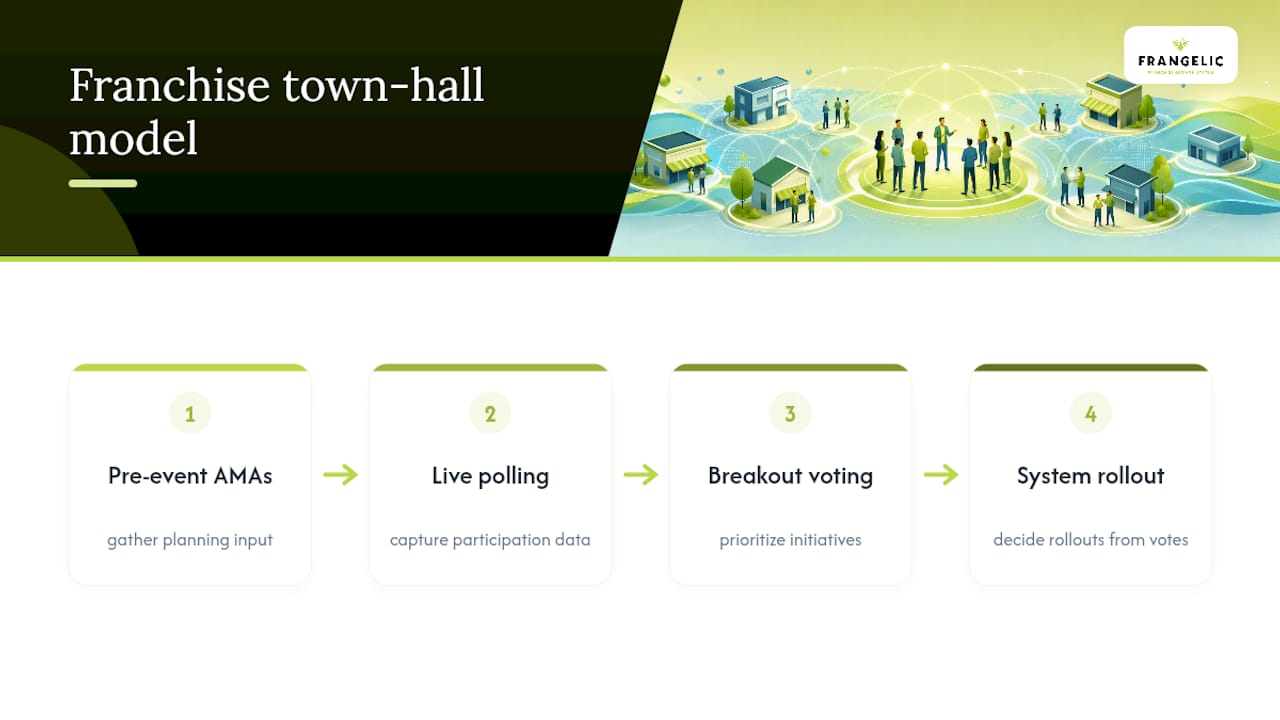
One recurring model in national franchise meeting design, described in BishopMcCann’s franchise playbook research, pairs pre-event AMAs with live polling during the main session, then uses breakout voting to prioritize which initiatives get system-wide rollout first. The measurable output is participation and adoption data captured in real time, not a gut feeling about how the room reacted.
Another pattern shows up in systems that treat the annual strategic planning meeting as a working session rather than a presentation. Acceler8Success’s research on responsible franchising describes meetings built around producing a tangible strategic plan with named accountability, distributed to the system almost immediately after the event ends. That speed of distribution, rather than the meeting content itself, is often what separates a plan that gets implemented from one that gets filed away.
The common thread across both patterns: the meeting is treated as the midpoint of a process, not the finish line. Planning and pulse-survey input come before it. A tracked, owned action plan comes immediately after it. The town hall itself is just the moment where the two connect.
How Frangelic Supports Franchise Town Halls That Actually Move the Needle
Running a franchise town hall well takes facilitation skill, a scripted agenda, and a follow-up system most internal teams haven’t built before, and building all three from scratch eats months you don’t have before your next system-wide meeting.
Frangelic works with franchisors on exactly this gap: facilitator training so your team can run breakouts and Q&A without losing the room, scripted agenda templates tied to measurable KPIs instead of generic update slides, and coaching on the follow-up systems that turn commitments into tracked, completed actions. Franchise brands that use structured coaching around these events typically see stronger owner confidence going into implementation, a lighter support-ticket load in the weeks after, and faster adoption of whatever initiative the meeting was built around, whether that’s a new marketing plan or a rollout plan for new locations.
If your next town hall needs to produce results instead of just attendance, start a conversation with Frangelic about building the agenda, training the facilitator, and setting up the follow-up scorecard before you send the calendar invite.
Sources
- 10 Ways to Improve Franchisee Communications - FRI: Franchise Relationships Institute
- Responsible Franchising in Action: Aligning Through Strategic Planning – Acceler8Success Cafe
- The Franchise Playbook – Crafting High-Impact National Franchise Meetings
- Franchise Meetings | Corporate Optics Blog
FAQ
How Often Should a Franchise System Hold a Town Hall?
Most systems run one major system-wide town hall annually alongside quarterly or monthly regional check-ins, keeping the big event reserved for strategic alignment rather than routine updates.
What’s the Difference Between a Town Hall and a Roundtable?
A town hall is typically a larger, often plenary session for updates and alignment, while a roundtable is a smaller, facilitated discussion format designed to surface balanced input and produce specific action items.
How Do You Stop a Town Hall From Turning Into a Complaint Session?
Use pre-submitted and anonymously voted questions, assign a trained facilitator with authority to redirect the room, and route individual grievances to a private follow-up process instead of the open floor.
What KPIs Should Measure a Franchise Town Hall’s Success?
Common metrics include program adoption rate within 90 days, attendance and participation rates, post-event sales lift, and franchisee satisfaction scores tracked through tools like NPS software.
Can Frangelic Help Run Our Franchise Town Hall?
Frangelic provides facilitator training, scripted agenda design, and post-meeting follow-up coaching for franchisors who want their town hall to produce measurable, tracked outcomes rather than just attendance.