
Franchisors: 90 Day Pilot to Build a Franchise Train the Trainer
A franchise train the trainer program teaches selected franchisees or managers how to certify their own staff, turning a franchisor’s playbook into consistent, repeatable execution across every location. The fastest path to a working program isn’t a full rollout. Pick one station or process, run it through a certification pilot, and use those results to scale.
TL;DR:
- Pilot one high-visibility station at a time to develop measurable certification gates based on observable behaviors rather than vague knowledge checks.
- Use a blended training approach combining online prework, field shadowing, in-person practice, and scheduled refreshers to scale effectively across multiple locations.
- Select trainers who demonstrate both technical competence and soft skills such as patience and clarity, and ensure they shadow certified trainers before independent certification.
- Budget should account for trainer time away from revenue, curriculum development, LMS costs, ongoing maintenance, and tools that support post-certification coaching and knowledge sharing.
- Establish clear governance roles, set review cadences, track key metrics like pass rates and customer satisfaction, and carefully control localization to balance standardization with regional adaptation.
What Is a Franchise Train the Trainer Program?
A franchise train the trainer program equips a small group of franchisees, managers, or field staff to deliver and certify training at the unit level, instead of leaving every location to interpret the operations manual on its own. Done well, it closes the gap between what the franchise disclosure document promises and what actually happens on the floor.
The business case is straightforward. Every location that improvises its own training creates its own version of “the way we do things,” and that variability shows up in customer complaints, food safety citations, or blown sales scripts. A structured trainer program compresses that spread and gives you a bench of people who can open new units or fix underperforming ones.
Core modules that belong in nearly every franchise training program:
- Operations: SOPs, equipment, safety, and quality checks specific to the concept
- Customer service: scripts, escalation handling, and brand voice
- Sales: upsell techniques, conversion tracking, and promotional execution
- Technology and LMS: point-of-sale systems, scheduling tools, and the learning platform itself
- Compliance: labor law basics, food safety certifications, and franchise-specific audits
- Financial basics: reading a P&L, labor cost percentages, and inventory control
- Leadership: delegation, coaching conversations, and conflict resolution
Programs that carry outside credibility tend to borrow structure from established credentials. Georgetown University’s Certificate in Franchise Management requires roughly 63 contact hours across two sessions, blending online prework with three days in person. University of Louisville’s franchise management certificate runs entirely online and awards credit toward the Certified Franchise Executive designation. Neither format is accidental. Both show that credible franchise training programs run on defined contact hours, not open-ended shadowing.
How Do You Design Curriculum and Certification Gates?
Curriculum design starts with a needs assessment, not a syllabus. Sit down with your top-performing units and your worst ones, and figure out where the gap actually lives. Is it a knowledge gap, a skill gap, or a motivation gap? Each requires a different fix, and most franchisors skip this step and write training for a problem that doesn’t exist.
- Pick one station to pilot. Don’t try to rebuild the whole manual at once. Choose a high-visibility, high-frequency task (a drive-through window, a POS transaction, a service recovery script) and build the module end to end.
- Write measurable learning objectives tied to observable behavior. “Understands customer service” is not testable. “Greets the customer within 10 seconds and confirms the order back verbally” is. Use the Tell-Show-Do-Review method: explain it, demonstrate it, have the trainee do it, then review performance together.
- Build certification gates. A real gate has four checkpoints: a knowledge test, a live demonstration, a coached delivery in front of real customers, and a manager sign-off. Skipping any one of these turns certification into a formality instead of a filter.
- Set a versioning and review cadence. Materials go stale the moment a menu, a POS system, or a regulation changes. Review every module on a fixed schedule, at minimum twice a year, and log version history so field teams know which version is current.
This mirrors how operators like Newk’s Eatery built certified trainer pathways one station at a time, using demonstration and observed shifts as the actual bar for certification rather than a completed checklist. That same pilot-first tactic shows up again and again in operator case studies because it keeps scope small enough to actually finish.
Pro Tip: Run your first certification gate on yourself or your training lead before asking a franchisee to sit for it. If you can’t pass your own test cleanly, the objectives are still too vague.
Which Delivery Methods Actually Scale?
The right delivery method depends on what you’re teaching, not what’s trendy. Hands-on tasks need field shadowing. Policy and compliance content works fine as e-learning. Most mature franchise systems end up running a blended model because no single format covers everything well.
- Instructor-led training (ILT): best for launch cohorts, leadership modules, and anything requiring group discussion
- Field shadowing: the only reliable way to teach physical tasks, register operation, or customer-facing scripts
- Virtual ILT: works for policy updates and refreshers across a geographically spread network
- E-learning through an LMS: ideal for compliance modules, product knowledge, and anything that needs a completion record
- Blended sequencing: prework online, in-person practice, field observation, then scheduled refreshers
A learning management system earns its cost the moment you need to prove who was trained, when, and how well they scored. Set up your LMS to track three things at minimum: completion rates, assessment scores, and observation checklist results tied to a real manager’s signature. Without that third piece, you have attendance data, not competency data.
A practical sequence that most franchise training programs converge on: assign short online prework before the in-person session, run guided practice with a certified trainer, follow with field observation over the first two weeks, then schedule a 90-day refresher. This structure isn’t arbitrary. Georgetown’s certificate program uses nearly the same shape, combining online prework with a compressed in-person block precisely because it respects how little time operators have away from the floor.
Who Should You Certify as a Trainer?
Technical skill alone doesn’t make someone a good trainer. Some of the best line performers freeze the moment they have to explain what they’re doing, and some of the most patient coaches were never the fastest employee on shift. Selection criteria need to weigh both dimensions.
Look for demonstrated technical competence first. A trainer candidate should already be performing the task at a high standard, consistently, without supervision. Then screen for the soft skills that actually matter in a coaching relationship: patience under repetition, clarity in explaining a step twice without frustration, and coachability, meaning they take feedback on their own teaching without getting defensive.
Once someone is selected, their own development needs structure:
- Adult learning principles: adults learn by doing, not by listening to a lecture, so build practice time into every module
- Feedback delivery: teach the “what, why, next” format (what you saw, why it matters, what to try next time) instead of vague praise or criticism
- Observation technique: train trainers to watch for specific behaviors on a checklist rather than forming a general impression
New trainers should shadow a certified trainer through several full sessions before running one solo. Staged autonomy protects the trainee’s experience and gives you a checkpoint to catch coaching problems before they spread across a unit.
Pro Tip: Score your trainers on their trainees’ outcomes, not just their own delivery. A trainer whose trainees consistently pass certification on the first attempt is worth more to your system than one who scores well on a peer review but produces shaky graduates.
How Do You Roll Out and Govern the Program?
A pilot needs the same rigor as a product launch: a clear objective, a fixed timeline, a defined sample size, and success criteria written down before you start, not after.
- Design the pilot. Choose one region or a handful of units, set a 60 to 90 day window, and define what success looks like in numbers (pass rate, time to certification, customer satisfaction shift).
- Assign governance roles. A training operations lead owns curriculum and version control. Field coaches handle observation and coaching. Franchisee certifiers sign off on individual trainees. Put this in writing so nobody assumes someone else owns updates.
- Set a review cadence. Governance groups should meet quarterly at minimum to review metrics and greenlight material updates.
- Report results against baseline. Compare pilot units to a matched set of non-pilot units on the same metrics.
| Metric | What it tells you |
|---|---|
| Completion rate | Whether trainees are finishing modules on schedule |
| Certification pass rate | Whether your gates are calibrated correctly, not too easy or too punishing |
| QA/audit scores | Whether certified skills are holding up during real shifts |
| Customer satisfaction shift | Whether training is translating into a better customer experience |
| Trainer retention | Whether the trainer role itself is sustainable, not just a one-time favor |
Programs that tie completion data directly to store-level evaluation scores create visible accountability. That link is what turns a training initiative into a measurable ROI story you can bring to a franchisee advisory council instead of a compliance mandate nobody wants to fund next year.
What Legal Risks Should Franchisors Watch For?
Joint-employer risk rises when a franchisor controls the day-to-day terms of a franchisee’s employees, not simply when it offers training. The safer structure is to provide materials, curriculum, and certification standards, but let franchisees deliver and adapt the actual training to their own staff.
- Provide training content and certification criteria; avoid directly supervising or disciplining a franchisee’s individual employees
- Encourage franchisee-led delivery, with your team acting as curriculum designer and coach rather than the on-the-ground instructor
- Document mandatory training carefully in your operations manual and keep the language consistent with what’s disclosed in your franchise agreement
- Keep certification records and completion logs; they protect you in a dispute and give you real performance management data
Legal advisors generally agree that providing training doesn’t automatically create joint-employer exposure, but delivery structure and control signals matter more than intent. The FTC is equally direct about disclosure accuracy: whatever training commitments you make in your FDD need to match what franchisees actually receive, or you’re building a liability into your own paperwork.
A 90-Day Pilot That Actually Produced Certified Trainers
Frangelic ran exactly this pilot-first approach with a multi-unit franchise client stuck at inconsistent execution across its top five locations. Instead of rewriting the entire operations manual, the team picked the highest-complaint station, built a single certification pathway around it, and ran it through one region for 90 days.
[case_study]
The 90-day pilot checklist Frangelic used with that client:
- Week 1 to 2: needs assessment, station selection, and objective drafting
- Week 3 to 5: build the module, write the knowledge test, and script the demonstration standard
- Week 6 to 8: run certification cohort one, collect pass rates and manager feedback
- Week 9 to 11: field observation and coaching adjustments based on real shift data
- Week 12: report results, decide on scale, and set the next station in the queue
[case_study]
The metrics worth collecting during any pilot: certification pass rate, time from enrollment to sign-off, manager confidence ratings, and a before/after comparison on whatever customer metric the pilot station touches most directly.
How Do You Localize Training for Different Franchise Locations?
A training module built for a suburban location with a young, hourly staff won’t land the same way in an urban unit with a bilingual crew or a rural location running with half the headcount. Localization isn’t about translating a PDF into Spanish and calling it done, though language matters and shouldn’t be skipped.
Build your core curriculum around the non-negotiables: brand standards, safety, and compliance items that can’t flex by location. Then build a layer underneath it that franchisees or regional trainers can adapt: local menu items, regional promotions, staffing patterns, or customer demographics that change how a script needs to land. A script written for a fast-casual concept in a college town needs different pacing than the same brand’s airport kiosk location.
Give trainers a customization framework instead of a blank check. Specify exactly which sections of a module are locked (safety steps, legal disclosures, brand voice on customer complaints) and which are open for local adaptation (specific product examples, regional slang, shift-timing scenarios). Without that distinction, some franchisees will “localize” their way out of the parts you actually need standardized.

Multilingual staff need more than a translated manual. Build assessment tools that can be delivered in the trainee’s working language, and make sure your certification gate, particularly the knowledge test, doesn’t accidentally test English proficiency instead of the actual skill. A trainer certification framework that only works in one language and one regional context will stall the moment your franchise system grows past its founding market.
How Do You Keep Trainers Engaged Over Time?
Trainer burnout is a real cost most franchisors don’t budget for. You’ve asked a top performer to take on extra responsibility, often for the same hourly wage, and if there’s no visible payoff, they’ll quietly stop volunteering for the role.
Recognition needs to be concrete, not just verbal. A small stipend, a title change, or priority scheduling for certified trainers signals that the role carries real weight in your system. Some franchise networks build a tiered trainer status (associate trainer, certified trainer, master trainer) tied to how many successful certifications a person has produced, which gives ambitious staff something to climb toward.
Give trainers a voice in curriculum updates. The people running certification sessions every week notice where a module drags or where trainees consistently stumble, long before that shows up in a corporate metrics dashboard. A short quarterly feedback loop where trainers flag friction points keeps your materials current and makes trainers feel like co-authors instead of enforcers of someone else’s rulebook.
Peer connection matters more than most franchisors expect. Trainers who only talk to their own store’s manager burn out faster than ones who can compare notes with a trainer three states away facing the same staffing problem. A structured peer coaching model gives trainers a support network that doesn’t route every question through corporate, which reduces your support team’s workload while making trainers feel less isolated in the role.
What Should a Train the Trainer Budget Actually Cover?
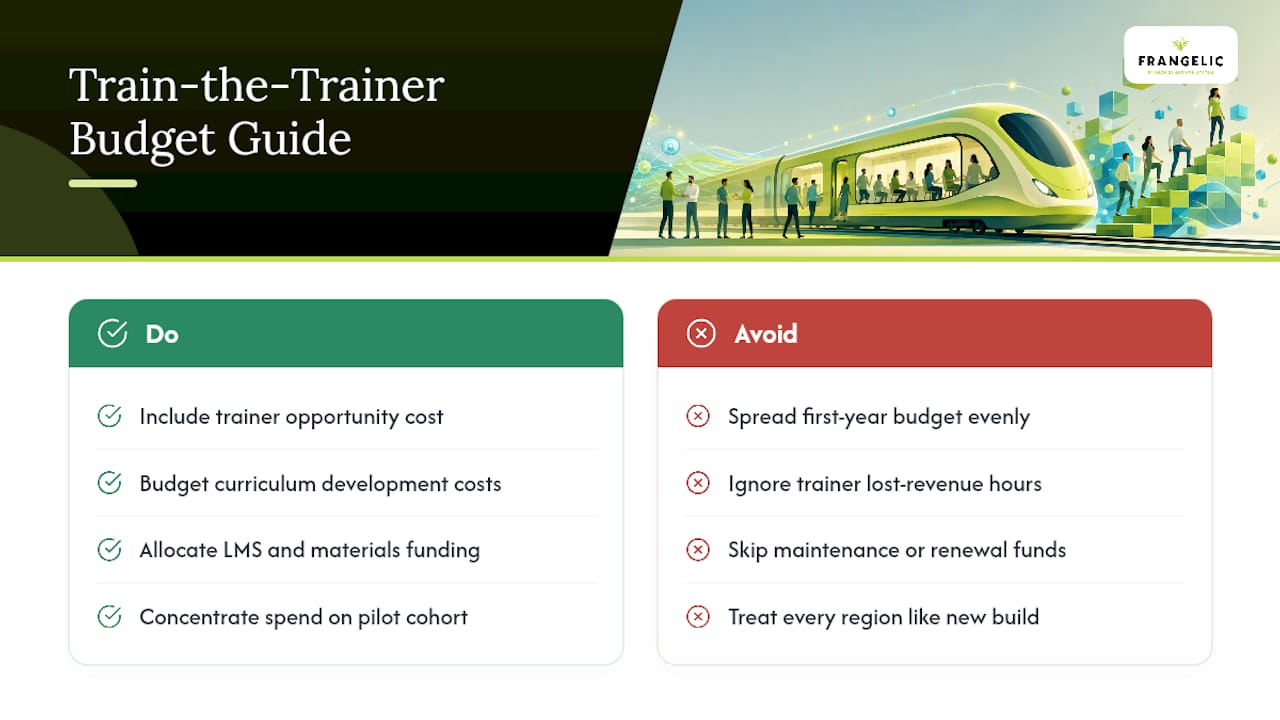
Franchisors consistently underbudget one line item: trainer time away from revenue-generating work. Every hour a top performer spends in a certification session or coaching a new hire is an hour they’re not on the floor, and that opportunity cost belongs in your budget math even though it never shows up as a line-item invoice.
Direct costs are easier to estimate. Curriculum development, whether built internally or with outside help, LMS licensing fees, printed or digital job aids, and any stipend or bonus structure for certified trainers all need a real number attached. If you’re benchmarking against industry programs, the IFA’s Foundations of Franchising bootcamp runs a six-week format with published pricing around $2,400 per participant, which gives you a rough sense of what structured, credentialed training costs at the individual level.
Resource allocation should follow the pilot-first principle from your rollout plan. Don’t spread your first-year training budget evenly across every station and every region. Concentrate it on the pilot station, the first cohort of trainers, and the LMS setup that will carry every module after it. Once the pilot proves out, scaling costs drop because you’re duplicating a working system instead of building one from scratch in every new territory.
Plan for an ongoing maintenance budget too, separate from the build cost. Materials need revision, certifications need renewal, and new hires need onboarding long after the initial rollout. A program with no maintenance line item quietly decays within a year.
How Can Technology Support Trainers After Certification?
Certification is the start of the relationship, not the end of it. Trainers who get certified and then never hear from corporate again tend to drift back into their old habits within a few months, simply because nothing is reinforcing the standard.
A digital community of practice, even something as simple as a dedicated channel or forum inside your existing communication tool, gives trainers a place to ask “how would you handle this” questions in real time instead of guessing or asking their store manager, who may not know the current standard either. The trainers who use these channels most tend to become your informal quality control network, flagging drift before it becomes a pattern.
Digital coaching tools add a layer beyond static content. Short video reviews, where a trainer records a coaching session and gets feedback from a field coach, catch technique problems that a written checklist misses entirely. Your LMS reporting also becomes a coaching tool in itself: a trainer whose trainees consistently score low on one specific competency is showing you exactly where their own coaching needs support, without anyone having to guess.
Knowledge sharing works best when it’s two-way. Build a simple way for trainers to submit a tip, a workaround, or a script that worked particularly well, and route the strongest submissions back into your official curriculum. The trainers closest to daily execution usually spot problems and fixes long before a training operations team sitting at headquarters does.
Get a Certified Trainer Pipeline Built for Your Brand
Building this program alone, on top of everything else on a franchisor’s plate, is exactly why most systems never get past the “we should really formalize training” stage. Frangelic runs the pilot design, curriculum build, and certification framework for you, then hands your team a working system instead of a binder that sits on a shelf.
Frangelic’s coaching system covers the full arc: picking the right pilot station, writing certification gates that hold up under real shift pressure, setting up LMS workflows that actually report the data you need, and coaching your training operations lead through the governance cadence that keeps materials current. Pricing runs as a per-franchisee subscription for ongoing coaching, with project fees for the initial curriculum build and pilot design, so you’re not locked into a flat annual contract before you’ve seen results from the first cohort.
If your system is still running training off tribal knowledge and a PDF nobody’s updated in two years, the next step is a straightforward one: bring Frangelic your top-performing and lowest-performing units and let us map where the gap actually lives. Visit the Frangelic franchise growth system to start that audit and get a pilot plan built around your first certification station.
Sources
- Certificate in Franchise Management — Georgetown University School of Continuing Studies
- Franchise Management Certificate — University of Louisville
- Franchise fundamentals: taking a deep dive into the Franchise Disclosure Document — FTC
- How to Build a Train the Trainer Program That Sticks — Opus