

How to Build a Franchisee Coaching Plan That Works
Use a 5-step, KPI-driven 8–12 week ramp-up plan that pairs monthly field check-ins with weekly 1:1 coaching sessions to move franchisees from launch to repeatable, measurable performance. That’s the blueprint. Everything below shows you exactly how to build it, run it, and prove it’s working.
Download the 12-week template and KPI scorecard at Frangelic’s Growth System and start with these three steps in the next 72 hours:
- Assign a named coach to every new franchisee before their first day of operation.
- Pull a KPI baseline (revenue, labor cost %, customer count) from week one data.
- Schedule the first field visit for no later than day seven post-opening.
Key Takeaways
A structured, KPI-driven franchisee coaching plan built on the five-step framework and a 12-week ramp-up cadence is the most direct path from a new franchisee’s opening day to repeatable, measurable performance.
| Point | Details |
|---|---|
| Start with the 5-step framework | Assess, prioritize, brainstorm, measure, and act — map each step to a weekly coaching session. |
| Use leading indicators from week one | Track labor schedule adherence and daily sales vs. forecast before reviewing lagging metrics like gross margin. |
| Match the coaching model to franchisee maturity | Use 1:1 field coaching for the first 90 days, then shift to a hybrid model as performance stabilizes. |
| Build ROI into the program from day one | Pull a clean baseline in week one so the before-and-after comparison is defensible to leadership. |
| Frangelic delivers the full system | The Frangelic Growth System includes the 12-week template, KPI scorecard, and CRM integration ready to deploy. |
What makes a franchisee coaching plan actually work?
The most effective franchisee coaching plans are built around a five-step framework: assess the situation with real data, prioritize the one or two issues that move the needle most, brainstorm solutions collaboratively with the franchisee, set measurable leading indicators to track progress, and close every session with a written action plan that names who does what by when.
Each step maps to a specific phase in the weekly coaching cadence:
| Step | Weekly Focus | Sample Coaching Questions |
|---|---|---|
| Assess | Weeks 1–2: data collection and baseline | “What does your sales data tell you about your busiest hours?” |
| Prioritize | Week 3: gap analysis and focus selection | “If you could fix one thing this week, what would it change?” |
| Brainstorm | Weeks 4–5: solution testing | “What have you tried before? What worked, even partially?” |
| Measure | Weeks 5–8: leading indicator review | “Is your labor schedule matching your traffic forecast?” |
| Act | Weeks 12–12: accountability and habit lock-in | “What will you do differently by next Tuesday?” |
Beyond those five anchors, the questions you ask inside each session determine whether a franchisee owns the solution or just nods along. High-value discovery questions include:
- “Walk me through last week’s numbers. Where did you expect to be?”
- “What’s the one constraint that, if removed, would change your results fastest?”
- “How confident are you in your team’s ability to execute this without you in the room?”
- “What does a great week look like for your location, specifically?”
- “Where are you spending time that your team should own?”
- “What would you tell a peer franchisee who’s six months behind you right now?”
Setting leading indicators rather than only lagging metrics is what separates coaching conversations that create ownership from ones that just review the scoreboard. When a franchisee tracks labor schedule adherence daily, they stop being surprised by margin slippage at month-end.
Which coaching model fits your franchisee’s stage?
No single model works for every situation. The right mix depends on franchisee maturity, your coach-to-franchisee ratio, and what you’re trying to change.
| Model | Best For | Pros | Cons | Recommended Span |
|---|---|---|---|---|
| 1:1 field coaching | New owners (0–3 months), remediation | High impact, builds trust fast, compliance-visible | High cost, hard to scale | 1 coach : 8–12 locations |
| Virtual 1:1 | Growth-stage owners (3–18 months) | Frequent touchpoints, lower travel cost | Loses compliance observation | 1 coach : about 15 to 20 locations |
| Group/cohort | Peer learning, common challenges | Scalable, peer accountability, low cost per head | Less personalized, scheduling friction | 8–15 franchisees per cohort |
| Peer coaching | Mature owners, brand ambassadors | High credibility, low franchisor cost | Quality varies, needs structure | Pairs or triads |
| Hybrid (field + virtual) | All stages, ongoing programs | Balances compliance and frequency | Requires scheduling discipline | 1 coach : 12–18 locations |
Hybrid coaching — combining in-person field visits with shorter virtual check-ins — gives you higher-frequency touchpoints without the travel budget of a purely field-based model. For most franchise systems, the practical recommendation is: lead with 1:1 field coaching in the first 90 days, then shift to a hybrid model as the franchisee stabilizes. Layer in group cohorts once you have five or more franchisees at a similar maturity level.
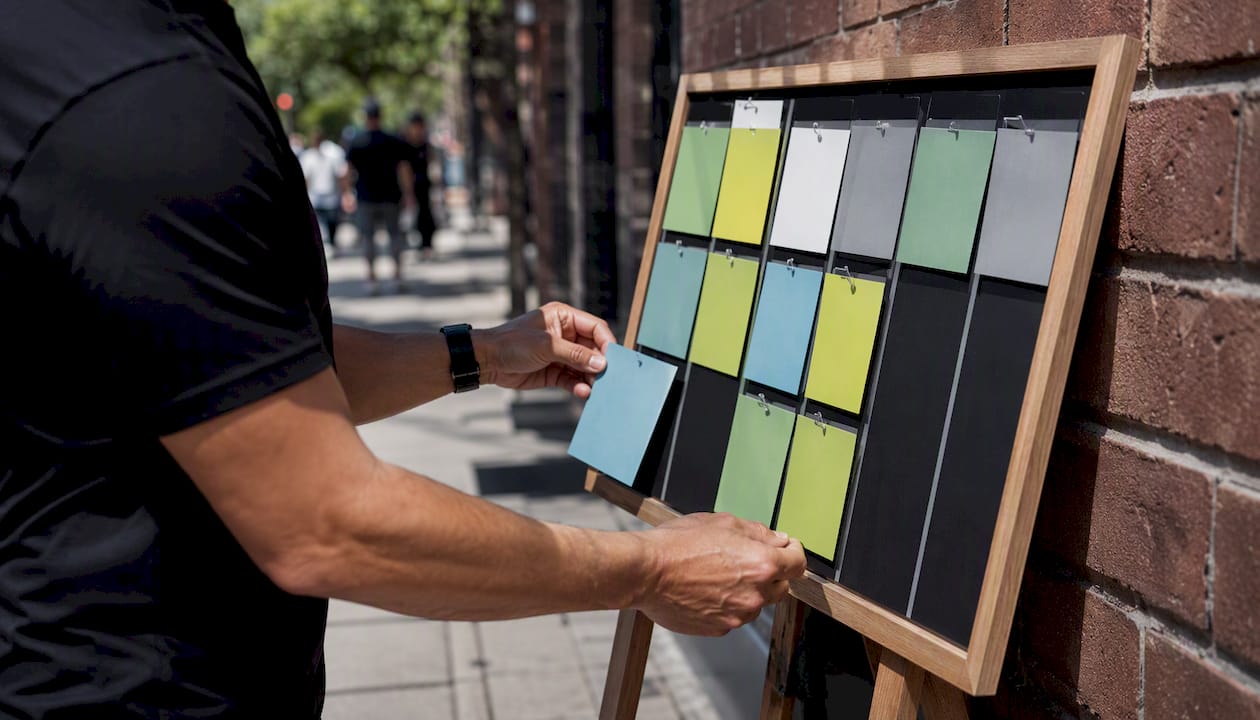
Peer-to-peer coaching models work best when franchisees have at least 12 months of operation under their belt. Pairing a top performer with a struggling owner, with a structured agenda and a coach facilitating, often produces faster behavior change than another franchisor-led session.
Pro Tip: Monthly check-ins are the recommended minimum cadence for field coaching because they leave enough time between sessions for franchisees to implement changes and generate new data to review.
A concrete sample 12-week franchisee coaching plan
This is the week-by-week plan. Copy it, customize the KPIs to your brand, and hand it to your coaches before the franchisee opens.
| Week | Goal | Coach Focus | Franchisee Deliverable | KPI to Track |
|---|---|---|---|---|
| 1 | Establish baseline | On-site field visit; observe operations | Complete opening checklist | Revenue day 1; customer count |
| 2 | Identify gaps | Review baseline data; prioritize top 3 issues | Submit gap analysis form | Labor cost % vs. target |
| 3 | Set leading indicators | Co-create 3 leading KPIs with franchisee | Signed KPI scorecard | Daily sales vs. forecast |
| 4 | Marketing activation | Review local marketing plan; assign tactics | Launch first local campaign | Lead generation actions taken |
| 5 | Operations review | Shadow one full shift; debrief | SOPs self-audit completed | Ticket time / throughput |
| 5 | Financial literacy | P&L walkthrough; cost-of-goods review | Annotated P&L submitted | Gross margin % |
| 5 | Mid-point assessment | Score KPI scorecard; celebrate wins | Mid-point self-assessment | KPI scorecard composite score |
| 8 | Team development | Observe team meeting; coach on delegation | Team accountability plan | Staff retention rate |
| 11 | Growth planning | Introduce growth-stage targets | Draft 90-day growth plan | Revenue vs. prior 4-week avg |
| 12 | Marketing performance | Review campaign results; adjust tactics | Campaign ROI report | Cost per new customer |
| 12 | Accountability lock-in | Review action plan completion rate | 90-day habit tracker | Action item completion % |
| 12 | Graduation review | Full KPI scorecard review; set next-phase goals | 12-week summary report | All KPIs vs. baseline |
Weekly session agenda (reusable template)
Each session runs 60 minutes. Time-box it or it drifts.
- 0–5 min: Check-in. One word for how the week felt. No elaboration yet.
- 5–20 min: KPI review. Franchisee presents their numbers first, coach asks questions second.
- 20–40 min: Priority issue deep-dive. Use the assess-prioritize-brainstorm sequence.
- 40–55 min: Action items. Three maximum. Named owner, specific deadline.
- 55–60 min: Close. Franchisee states their single biggest commitment for the week.
Opening week checklist
The first week sets the tone for the entire ramp-up. Don’t skip these:
- Coach on-site for at least two of the first five operating days.
- Baseline KPIs pulled and entered into the dashboard by day three.
- Franchisee has read and signed the KPI scorecard before the week-one session.
- First 1:1 session scheduled and confirmed for day five or six.
- Local marketing campaign assets approved and ready to deploy.
- Franchisee has access to the LMS and has completed any required pre-reads.
Structured onboarding programs that include pre-work, academy training, field mentorship, and a guided first-six-month curriculum consistently produce faster operational readiness. The week-by-week plan above is designed to deliver exactly that structure for any franchise model.
How to run financial coaching sessions that change behavior
Financial coaching is where most franchise coaching programs go soft. Coaches review the P&L, the franchisee nods, nothing changes. The fix is to lead with leading indicators, not the income statement.
Top financial KPIs to track (leading and lagging):
- Leading: Daily sales vs. forecast; labor hours scheduled vs. actual; food/product cost % by week; cash-on-hand vs. operating reserve target
- Lagging: Monthly gross margin %; net operating income; accounts payable aging; revenue per labor hour
A financial coaching session follows four steps: the franchisee submits a pre-read (their P&L and the week’s leading KPIs) 24 hours before the call. The session opens with the franchisee’s own read of the numbers, not the coach’s. Then the coach asks questions. Action items close the session, with a measurement date attached to each one.
High-impact questions that actually drive behavior change:
- “Your labor cost is three points above target. What happened on Tuesday and Thursday specifically?”
- “If gross margin drops another point next month, what’s the first thing you’d cut?”
- “What would it take to hit your revenue target without adding a single new customer?”
- “You’ve hit your sales goal two weeks in a row. What did you do differently?”
The last question matters as much as the others. Coaching programs that only focus on problems miss the chance to reinforce what’s working, which is where sustainable behavior change actually comes from.
How to recruit, train, and assess franchise coaches
A coaching program is only as good as the people running it. Hiring a great operator and calling them a coach is the most common mistake in franchise systems.
Coach skills and competencies checklist
Before hiring or promoting a franchise business coach, confirm they can demonstrate:
- Active listening and question-based facilitation (not advice-giving as a default)
- Operational fluency in your brand’s core processes (they’ve worked in or closely with a location)
- Financial literacy: can read a P&L, explain food cost variance, and spot a cash flow problem
- Data literacy: comfortable pulling and interpreting dashboard metrics without IT support
- Coaching certification or equivalent structured training (ICF credential or brand-specific program)
- Conflict resolution and difficult-conversation skills
- Ability to distinguish between coaching (capability gap) and consulting (knowledge gap)
Effective franchise business consultants blend coaching and compliance and use data dashboards to make conversations specific rather than impression-based. That means your coaches need to be as comfortable with a spreadsheet as they are with a conversation.
Observation rubric for coach quality
Score each criterion 1–4 (1 = not demonstrated, 4 = consistently excellent):
- Opens session with franchisee’s data, not coach’s agenda
- Asks at least three open-ended questions before offering a suggestion
- Action items are specific, measurable, and franchisee-owned
- Closes with franchisee stating their own commitment
- Follows up on prior session’s action items before introducing new topics
Caseload and growth targets
Start new coaches at eight to ten locations. After 90 days, review session quality scores and franchisee KPI trends before expanding the caseload. A coach running more than 18 locations in a hybrid model will almost always sacrifice session depth for volume. Building a coaching team that scales without losing quality requires clear caseload caps and a peer review process for coach sessions.
What tools and templates does your coaching program need?
The tools are not the program. But without the right infrastructure, even a well-designed coaching plan collapses under administrative weight.
Essential templates every program needs:
- KPI scorecard: Leading and lagging metrics, updated weekly by the franchisee, reviewed in every session.
- Session agenda template: Time-boxed, with a pre-session data submission requirement.
- 12-week coaching plan template: Week-by-week goals, deliverables, and KPIs (the table above is your starting point).
- Coach observation rubric: Scoring criteria for session quality, used in monthly coach reviews.
- RACI matrix: Who owns onboarding, coaching, tech setup, KPI baseline pulls, and escalation.
- Franchise business plan template: Used in weeks 11–12 to build the franchisee’s growth-stage plan. A practical template gives franchisees a structured starting point.
Tool categories to integrate:
- Dashboard/BI tool: Centralizes KPI data across locations. Brands that give coaches comparative visibility across locations reduce perception-driven coaching and increase specificity in action plans.
- LMS (Learning Management System): Hosts pre-reads, certification modules, and recorded sessions. Leading franchise training programs pair in-location learning with a structured LMS curriculum.
- CRM: Tracks coaching session notes, action items, and follow-up dates. Without a CRM, accountability falls through the cracks between sessions.
- Scheduling tool: Reduces the administrative friction of booking recurring sessions across a large network.
- Screen sharing / video platform: Required for virtual 1:1 and group cohort sessions.
On data hygiene: the dashboard is only useful if franchisees enter data consistently. Build the data submission habit in week one. If a franchisee misses two consecutive submissions, that’s a coaching conversation, not an IT ticket.
How do you measure coaching ROI and report it to leadership?
The ROI conversation is where coaching programs either earn ongoing investment or get cut. Build the narrative before leadership asks for it.
Leading indicators map to lagging outcomes
| Leading Indicator | Lagging Outcome |
|---|---|
| Labor schedule adherence (%) | Labor cost % / gross margin improvement |
| Daily sales vs. forecast variance | Monthly revenue attainment |
| Action item completion rate | KPI scorecard composite score improvement |
| Session attendance rate | Franchisee satisfaction and retention |
| Local marketing actions completed | New customer acquisition rate |
Sample ROI calculation approach
The formula is straightforward: incremental revenue attributable to coaching divided by total coaching cost (coach salary/fees + travel + tools). If a cohort of ten franchisees averages $8,000 more in monthly revenue after the 12-week program than before it, and the program cost $15,000 to run, the 12-week ROI is roughly 5:1 on an annualized basis. The key is establishing a clean baseline in week one so the “before” number is defensible.
Field coaching programs with clear KPIs and a regular cadence produce the most defensible ROI data because the measurement structure is built into the program from day one, not retrofitted after the fact.
Reporting cadence
- Weekly: Coach submits session notes and action item status to the coaching manager.
- Monthly: KPI scorecard composite scores reviewed across all coached locations; outliers flagged.
- Quarterly: Executive summary: revenue trend, KPI movement, coaching cost, and ROI calculation.
- Annually: Full program review: coach quality scores, franchisee graduation rates, and network-wide KPI benchmarks.
Launch checklist for the first 90–180 days
Getting the program off the ground is a project, not just a policy. Treat it like one.
RACI snapshot:
- Onboarding design: Franchisor leadership owns; coaching manager executes.
- Coach hiring and training: HR and coaching manager own; field operations consults.
- Tech setup (dashboard, LMS, CRM): IT owns; coaching manager accepts.
- KPI baseline pulls: Coach owns; franchisee provides data.
- Escalation protocol: Coaching manager owns; franchisor leadership approves.
30/60/90/180-day milestones:
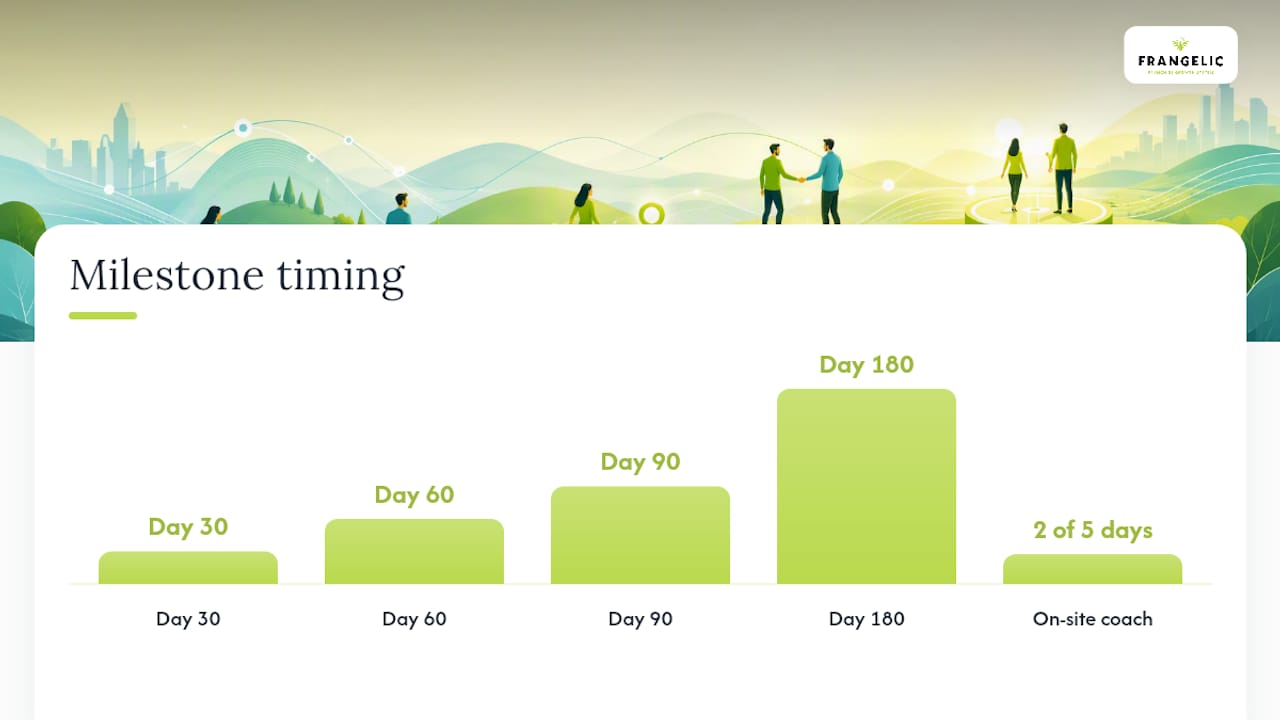
- Day 30: All coaches assigned, trained, and carrying their initial caseload. KPI baselines pulled for every active franchisee. First session completed for every new franchisee.
- Day 60: First monthly check-in completed. KPI scorecard composite scores reviewed. At least one group cohort session held if you have five or more franchisees at a similar stage.
- Day 90: Mid-point assessments completed for franchisees in the 12-week plan. Coach observation rubric scores reviewed. Any caseload adjustments made.
- Day 180: First full cohort graduates the 12-week plan. ROI calculation completed and presented to leadership. Growth-stage coaching plans in place for graduates.
Large franchise systems often deploy franchisor field teams on-site during opening week. If your system can’t match that scale, a single dedicated coach on-site for two of the first five days achieves most of the same benefit.
Common pitfalls and fixes:
- Over-meeting: If coaches are running more than two sessions per franchisee per week in the first month, they’re compensating for unclear action items. Fix: tighten the session agenda and enforce the three-action-item cap.
- Data overload: Franchisees who receive 15 KPIs in week one disengage. Fix: start with three leading KPIs and add metrics only after the franchisee demonstrates consistent tracking.
- Unclear accountability: When action items don’t have a named owner and a specific date, they don’t get done. Fix: the RACI and the session agenda template solve this structurally.
- Coaching only when problems arise: Reactive coaching misses the compounding benefit of consistent touchpoints. Fix: schedule the full 12-week cadence before the franchisee opens.
A Frangelic case example: from uncertain launch to measurable growth
A multi-unit franchisee in a service-based brand came to Frangelic eight weeks after opening with declining weekly revenue, a labor cost running six points above target, and a support team fielding daily calls from the owner. The franchisee had completed initial brand training but had no structured coaching cadence and no KPI scorecard in place.
Frangelic deployed the 12-week coaching plan with a hybrid model: weekly virtual 1:1 sessions and one monthly field visit. The coach used the five-step framework to identify that the core issue was scheduling, not sales. Labor was being scheduled based on gut feel rather than traffic data. Within three weeks of introducing a daily labor schedule adherence KPI, the franchisee’s labor cost dropped toward target.
By week 12, the results were measurable:
The franchisor’s support team reported a significant reduction in reactive calls from this location within 60 days of the coaching program starting. That reduction in home-office workload is one of the clearest signals that a franchise coaching program is working: the franchisee stops needing to be rescued and starts running their business.
Frangelic gives you the plan, the templates, and the coaching system
Frangelic is built for exactly this situation: a franchisor or franchise coach who knows coaching matters but needs a ready-to-run system rather than another framework to build from scratch.
The Frangelic Growth System includes the 12-week coaching plan template, KPI scorecard, session agendas, coach observation rubric, and CRM integration guidance, all packaged for immediate deployment. With over 20 years of experience in franchising and marketing, Frangelic’s approach is built around one goal: franchisees who grow their revenue without leaning on the support team for every decision.
What franchisors gain from the system:
- Faster franchisee ramp-up with a structured week-by-week plan that starts on day one.
- Measurable KPI dashboards that make coaching conversations specific and defensible.
- Less home-office workload as franchisees build the skills and confidence to self-manage.
Request a demo or download the 12-week template directly at Frangelic and have your first coached franchisee on a structured plan within the week.
Sources
The following sources informed the framework, cadence recommendations, and coaching model guidance throughout this playbook:
- Coaching Up: Set up a 5-step framework to solve problems
- Franchise field coaching KPIs and cadence guide
- Franchise Business Consultant Program Tips - FranConnect
- Franchise training
- World-class franchise training program
- Franchise training program