
Item 19 Checklist That Passes FTC and State Review for U.S. Franchisors
Item 19 is optional, but any earnings claim made anywhere still has to appear in Item 19 and satisfy the Franchise Rule’s reasonable-basis and substantiation tests. If you make a financial performance representation, you need contemporaneous data, a documented methodology, and records ready to hand over on request. Skip that discipline and you’re looking at FTC enforcement exposure, state examiner pushback, and potential rescission claims from franchisees who relied on numbers you can’t back up.
TL;DR:
- Most franchisors omit Item 19 entirely, risking enforcement issues if they make unsupported earnings claims during sales activities.
- Valid Item 19 disclosures must be based on FDA-compliant data sources, include clear cohort definitions, and be supported by documented methodology.
- Public-facing marketing materials or sales discussions referencing income or profit figures must match the data in Item 19 or avoid mentioning specific numbers altogether.
- State registration reviews often scrutinize and require explanations for cohort selection, data sources, and exclusions to prevent misleading representations.
- Material changes to franchise performance data or business models require prompt amendments to Item 19 to maintain disclosure accuracy and legal compliance.
What Item 19 Is and When You Must (or Must Not) Use It
Item 19 is the section of the Franchise Disclosure Document where a franchisor may report a Financial Performance Representation, or FPR, meaning any statement about actual or potential sales, income, gross profit, or net profit tied to franchised or company-owned outlets. The Franchise Rule enforced by the FTC does not require Item 19. It requires that if you make one, you make it there and nowhere else.
That distinction trips up more franchisors than any other part of the disclosure regime. A regional sales director who tells a prospect on a call that “our top locations clear $400,000 a year” has just made an unauthorized FPR, even if the number is accurate, even if it’s buried in an otherwise compliant sales process. The claim has to live in Item 19 or it can’t be made at all.
Common triggers that turn casual conversation into a legal problem:
- Sales calls or discovery meetings where a rep cites revenue, profit, or return-on-investment figures
- PowerPoint decks or brochures used at trade shows or franchise expos
- Discovery Day presentations where existing franchisees share performance numbers
- Website copy, social media posts, or testimonials that reference specific dollar figures
- Financing pitch materials shared with prospects to help them secure a loan
If any of those channels touch a number, that number needs backing in Item 19, or your sales team needs a script that avoids figures entirely. There’s no middle ground under the Rule.
Federal Requirements Under 16 C.F.R. §436.5: Reasonable Basis and Substantiation
The federal test comes straight from 16 C.F.R. §436.5, which spells out what Item 19 must contain when a franchisor chooses to include one. The rule requires you to state whether a representation is historical or prospective, disclose the basis for the claim, and identify the material assumptions behind any projection.
“Reasonable basis” isn’t a vague standard you can satisfy with good intentions. It means:
- Data source quality — figures pulled from audited financial statements or verified point-of-sale systems carry more weight than self-reported franchisee estimates
- Adequate sample size — a claim built on three outlets reads very differently from one built on eighty
- Contemporaneous records — the underlying data has to exist at the time the claim is made, not reconstructed after the fact to fit a marketing narrative
- Consistent methodology — the same calculation logic applied across every unit in the cohort, with no cherry-picking
Written substantiation is the file that proves all four points hold up. It should show exactly where each number came from, how outliers were treated, and why the chosen time period is representative rather than convenient.
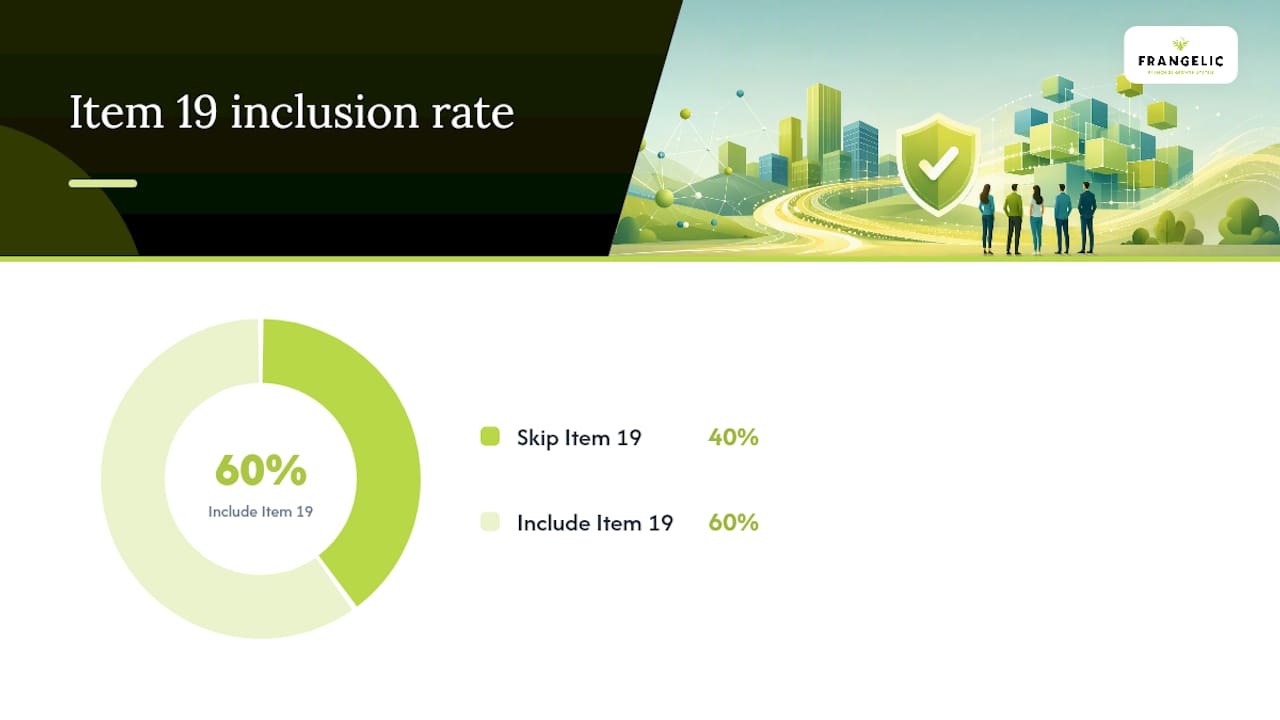
Roughly 40% of franchisors skip Item 19 entirely, according to one analysis of FDD filings. Omitting it doesn’t remove risk; it just shifts the risk to the sales floor, where the temptation to mention “what our best franchisees make” is constant and the compliance guardrails are thinner.
Beyond reasonable basis, §436.5 requires specific disclosure elements:
- The time period the representation covers
- The number of outlets included and how many were excluded, with reasons
- A clear cohort definition (company-owned, franchised, mature units, or some combination)
- Material assumptions underlying any prospective or averaged figure
- A statement that substantiating data is available on reasonable request
Miss any one of those five and the disclosure is incomplete even if the underlying numbers are accurate.
State Registration, NASAA Guidance, and Examiner Review
Federal compliance is the floor, not the ceiling. States that require franchise registration, including California, New York, and Illinois, run their own review of Item 19 before clearing an FDD for sale, and examiners in those states routinely ask questions the federal Rule doesn’t explicitly require answering.
NASAA’s commentary on financial performance representations pushes franchisors toward greater transparency than the bare federal minimum, particularly around methodology disclosure and sample adequacy. Examiners want to see the logic, not just the output.
Practical steps that speed up state review instead of triggering a deficiency letter:
- Attach a short methodology annex explaining how the cohort was defined and how outliers were handled
- Keep a substantiation folder organized by claim, so each number in Item 19 maps to a specific source document
- Be ready to explain, in plain language, why certain outlets were excluded from the cohort
- Anticipate examiner questions about small sample sizes and address them in the disclosure itself rather than waiting for a comment letter
- Cross-check that Item 19 language matches what your sales materials and franchisee agreements say elsewhere in the FDD
A franchisor who treats state review as an afterthought usually ends up amending Item 19 twice: once because an examiner flagged it, and once more because the fix introduced a new inconsistency. Building the methodology annex before submission avoids both rounds.
Building a Compliant Item 19: Data, Cohorts, Methodology, and Substantiation
Start with the data, not the disclosure. The strongest Item 19 sections are built backward from clean records rather than forward from a marketing goal.
Acceptable data sources include audited or reviewed financial statements, point-of-sale exports timestamped at the point of collection, franchisee-submitted royalty reports cross-checked against bank deposits, and company-owned unit accounting pulled straight from your general ledger. Self-reported figures that can’t be verified against a second source are the weakest link in any substantiation file, and they’re usually the first thing an FTC investigator or plaintiff’s attorney asks to see.
Cohort selection determines whether your disclosure is defensible or a liability waiting to surface. Decide early whether you’re reporting on company-owned units, franchised units, or both, and whether “mature” means open twelve months, twenty-four months, or something else specific to your business cycle. A cohort of five-year-old flagship locations in dense urban markets tells a prospect almost nothing useful about what a rural single-operator franchise should expect in year one. Geographic splits matter too: a national average can mask regional variation wide enough to make the disclosure misleading even when the math is technically correct.
Metrics worth including go beyond top-line revenue:
- Gross revenue by cohort and time period
- Gross margin or cost-of-goods percentage
- Operating expense ratios (labor, occupancy, marketing spend)
- Estimated EBITDA ranges where the data supports it
Showing part of the cost stack, not just revenue, gives prospective franchisees enough context to build their own realistic model rather than assuming your top-line number translates directly into take-home profit. That’s the difference between an Item 19 that helps close qualified buyers and one that generates disappointed franchisees eighteen months later.
Pro Tip: Keep a standing “substantiation binder,” physical or digital, updated every time you refresh Item 19 numbers. When a state examiner or a franchisee’s attorney asks for the basis behind a figure, you want to hand over a folder, not scramble to reconstruct one under deadline pressure.
When you get a reasonable request for backup data, respond with the specific source documents tied to the claim in question, not a general summary. Franchisees and their counsel are within their rights to ask, and stonewalling a legitimate request does more reputational damage than the underlying number ever could.
Common Item 19 Formats, Disclosure Examples, and Red Flags
Most compliant Item 19 sections use one of three formats: a straight average with range, a median with quartile breakdown, or a tiered table showing top, middle, and bottom performance bands by cohort. Quartile and median formats tend to hold up better under scrutiny because they don’t let a handful of outlier locations pull the headline number away from what a typical franchisee actually experiences.
Every table needs footnotes that state the sample size, the exact time period covered, and any exclusions with a brief reason. A table showing “$650,000 average unit revenue” with no footnote is functionally meaningless and legally risky. The same table with “$650,000 average unit revenue, based on 42 of 58 company-owned outlets open at least 24 months as of December 31, 2025; 16 outlets excluded due to incomplete fiscal-year data” is a disclosure counsel can defend.
Language choices matter as much as the numbers themselves:
- Weak: “Franchisees can expect to earn similar results.” (implies a guarantee, invites reliance claims)
- Strong: “The following figures reflect historical performance of a specific cohort and are not a guarantee or projection of future results for any individual franchisee.”
- Weak: “Top performers make significantly more.” (vague, unquantified, invites follow-up questions you can’t answer)
- Strong: “The top quartile of the cohort generated between $X and $Y in gross revenue during the stated period.”
Watch for these red flags before publication:
- Selective sampling that quietly drops underperforming units without disclosure
- A missing or vague outlet count that makes the cohort impossible to verify
- Undisclosed exclusions, especially units that closed or were terminated during the reporting period
- Projecting confidently from a sample of five or ten units without a small-sample caveat
- Mixing company-owned and franchised data without labeling which is which
When a cohort is genuinely small, the safer move is a conservative disclosure: wider ranges, an explicit small-sample footnote, or limiting the claim to company-owned outlets where you control the data quality directly. That approach costs you some marketing punch, but it holds up far better than a precise-looking number built on a shaky foundation.
Pre-Publication Checklist and When to Amend Item 19
Before Item 19 goes into a new FDD or renewal filing, run through this sequence:
- Validate every underlying data point against its source document, not against last year’s disclosure
- Confirm the cohort definition still matches current operations, especially after growth, closures, or a change in your franchise model
- Draft footnotes covering sample size, time period, and exclusions before counsel review, not after
- Have franchise counsel review the full section against §436.5 and any state-specific commentary
- Assemble or update the substantiation binder so it mirrors exactly what’s published
- Get sign-off from whoever owns the financial data, usually your CFO or controller, confirming the numbers tie to company records
Item 19 needs amendment when something material changes the accuracy of what’s disclosed: a significant shift in average unit revenue, the addition or closure of a meaningful number of outlets in the cohort, a change in fee structure that affects net margins, or a shift in the business model itself (adding a delivery channel, changing a supply agreement, and so on). Most states expect amendments filed promptly rather than waiting for the annual renewal cycle, particularly when the change would make an existing disclosure misleading to a prospect currently in the sales pipeline.
Pro Tip: Set a quarterly internal audit cadence, even in years without a major FDD amendment. Reviewing Item 19 data every quarter catches drift, a cohort that’s grown stale, an exclusion nobody remembers the reason for, before it becomes a disclosure problem instead of a bookkeeping one.
Retain substantiation records for at least as long as the Item 19 disclosure they support remains in circulation, and longer where your state’s statute of limitations on franchise claims extends beyond that period. A well-run franchise rollout plan treats this recordkeeping discipline as part of the operating rhythm, not a once-a-year scramble before renewal.
Sources
For direct verification, start with the FTC’s Franchise Rule and the exact regulatory text at 16 C.F.R. §436.5. The FTC’s own plain-language breakdown of the FDD offers practical examples worth reading alongside the rule text. For compliance programs that intersect with franchise operations touching sanctioned jurisdictions or third-party financing, see OFAC’s compliance framework and FinCEN’s customer due diligence rule.
If your sales team needs training on where the compliance line sits, Frangelic’s guidance on franchisee onboarding covers how to prep reps to talk about performance without straying outside Item 19.
A franchisor who gets Item 19 right isn’t just avoiding an FTC letter. Clear, well-substantiated disclosures build trust with prospective franchisees before they sign, which is exactly the kind of confidence that reduces disputes down the road and strengthens the franchisee relationships your brand depends on for organic growth. Some firms work with franchisors to turn that compliance discipline into a recruitment advantage, helping brand leaders pair honest financial disclosure with coaching and onboarding systems that support new franchisee performance. If you’re building or revising a growth plan around a stronger Item 19, Frangelic can help you connect the disclosure to the operational support that makes it accurate.
This article is general information, not a substitute for advice from a qualified lawyer. Consult a qualified legal professional about your own circumstances before acting on anything here.
FAQ
What Is an Item 19?
Item 19 is the section of the Franchise Disclosure Document where a franchisor may report a Financial Performance Representation, meaning specific claims about franchisee sales, costs, or profits, backed by a reasonable basis and written substantiation.
Can You Open a Chick-fil-A for $10,000?
No. That figure circulates online but doesn’t reflect actual franchise investment costs; specific investment ranges appear in the franchisor’s FDD under Item 7, and prospective franchisees should verify current figures directly against the FDD rather than secondhand claims.
Is an FDD Legally Required?
Yes. The Franchise Rule requires franchisors to provide an FDD containing 23 specific disclosure items to prospective franchisees before any sale, though Item 19 within that document remains optional.
How Hard Is It to Get Out of a Franchise Agreement?
Exiting a franchise agreement is typically difficult and governed by the specific termination and transfer clauses in that agreement, often involving notice periods, de-identification requirements, and sometimes a buyout or approval process controlled by the franchisor.