

Social Media Marketing for Franchises: 2026 Guide
Social media marketing for franchises is the process of coordinating brand-consistent, locally relevant content across multiple locations to drive visibility, leads, and customer engagement. Most franchise networks fail not because of bad content, but because they treat every location the same way. The franchises that win in 2026 build systems that let corporate control the brand while franchisees own the local conversation. Increasing the network publication rate from 15% to 80% can produce a 433% increase in social-generated leads within 12 months. That single metric tells you everything about what consistency at scale actually means.
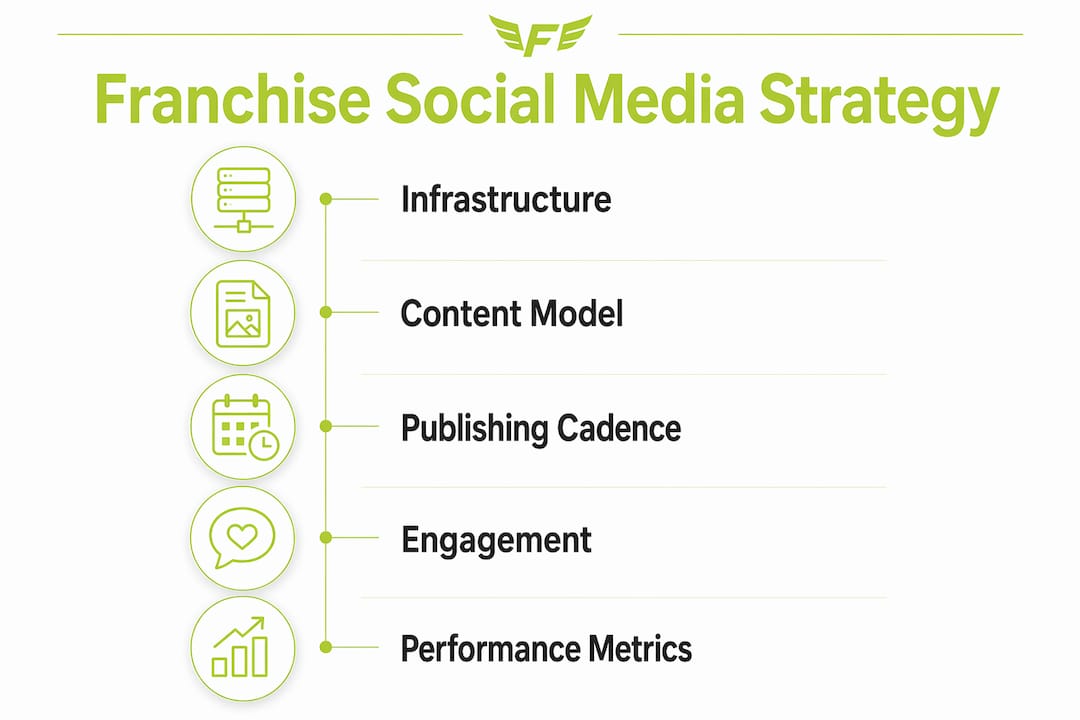
What does social media marketing for franchises actually require?
Franchise social media marketing is not a single-location strategy multiplied by your number of units. It is a coordinated system with defined roles, shared infrastructure, and clear governance. Getting the foundation right before you post a single piece of content is the difference between a network that grows and one that drifts.
The infrastructure you need first
Meta Business Suite and Google Business Profile location groups are mandatory infrastructure for any multi-location franchise. Without them, you cannot manage assets at scale, assign roles correctly, or run centralized campaigns with local targeting. The franchisor holds the “Admin” or “Primary Owner” role. Each franchisee receives a “Manager” role, which gives them enough access to post locally without touching brand-level settings.

A social media charter is the next non-negotiable. This document specifies what franchisees can post, what requires approval, and what is off-limits entirely. Think of it less as a restriction and more as an empowerment tool. Franchisees who know the rules post more confidently, and that confidence shows up in your network publication rate.
Essential tools for franchise social media management
The right tools reduce the manual labor of managing dozens or hundreds of locations. Each category below serves a specific function in the franchise social media workflow.
Scheduling and publishing: A centralized platform that lets corporate push content to all locations while franchisees can add local posts within preset guardrails.
Analytics and reporting: Dashboards that show both network-wide performance and individual location data, so you can identify which units are underperforming.
Brand compliance: Built-in approval workflows, banned language filters, and visual asset libraries that enforce standards without requiring a manual review of every post.
Google Business Profile management: Tools that sync location data, hours, and posts across all profiles from one interface.
AI content generation: Systems that produce localized post copy by city, neighborhood, and keyword, reducing the writing burden on franchisees.
Pro Tip: Set your network publication rate target before you choose your tools. A target of 3–5 posts per week per location with more than 70% of locations actively publishing is the benchmark that separates high-performing franchise networks from the rest.
How to design a franchise social media strategy that actually scales
The most effective franchise social media strategy avoids two extremes. All-centralized control produces generic content that local audiences ignore. All-local autonomy produces off-brand posts that damage the network. The answer is a structured middle ground.
The hub-and-spoke content model
The hub-and-spoke model divides content into three tiers: 70% corporate content pushed to all locations, 20% locally customized versions of corporate content, and 10% franchisee-created original posts. Corporate content covers brand campaigns, product launches, and national promotions. Locally customized content takes those same campaigns and swaps in city names, local offers, or location-specific images. Franchisee-created content covers staff spotlights, local events, and community moments that only that location can authentically produce.
This split matters because it gives franchisees a manageable creative workload. Most franchisees are operators, not marketers. Asking them to create all their own content from scratch leads to inconsistent posting or no posting at all. The hub-and-spoke model gives them a ready-made content base and asks them to add local color, not build from zero.
Tiered approval workflows
Tiered approval workflows based on content risk are the governance standard for 2026. Routine local content, such as a staff spotlight or a local event announcement, publishes automatically within preset guardrails. Sensitive content, such as anything touching pricing, legal claims, or crisis response, routes through a multi-stage human review. This approach eliminates the bottleneck of reviewing every post while maintaining brand safety where it counts.
Define content risk tiers. Categorize post types by risk level: low (local events, team photos), medium (promotional offers, product claims), and high (crisis response, legal or health-related content).
Build guardrails into your publishing platform. Embed brand voice standards, visual templates, and banned language lists directly into the content dashboard so compliance happens automatically.
Map your content calendar. Block corporate campaign dates first, then leave space for local events and franchisee-created posts each month.
Use AI for localization. AI tools can generate location-specific post copy within brand guardrails, cutting content creation time dramatically.
Review and adjust quarterly. Pull network-level data every quarter and update your content mix based on what is driving local intent actions.
Pro Tip: Embed your social media charter directly into your publishing platform rather than distributing it as a PDF. Governance embedded in tools outperforms governance distributed as documents every time.
What are the best practices for franchise social media content and engagement?
Content execution is where most franchise social media programs break down. The strategy looks good on paper, but the day-to-day posting becomes inconsistent, the engagement goes unanswered, and the metrics drift toward vanity numbers that do not connect to revenue.
Posting frequency and content formats
The target is 3–5 posts per week per location, with more than 70% of your network actively publishing. That frequency keeps each location visible in local feeds and supports local search signals. Content formats should vary by platform. Facebook and Instagram support carousels for product showcases, short video for behind-the-scenes content, and static images for local offers. Location tagging and localized lead form ads tailored per franchise location drive measurable lead generation on both platforms.
Staff spotlights and local community posts consistently outperform generic brand content in local markets. A post featuring a named team member at a specific location generates more comments and shares than a polished national campaign image. That local authenticity is exactly what the 10% franchisee-created tier in the hub-and-spoke model is designed to capture.
Engagement and response protocols
Set a response time standard. Respond to comments within 4 hours during business hours. Slow responses signal to both customers and algorithms that the account is inactive.
Create templated responses for common questions. Franchisees should not write every reply from scratch. Give them approved language for pricing questions, hours, and complaints.
Define your escalation path. Any review or comment involving a legal claim, health concern, or public crisis routes immediately to the franchisor’s marketing team.
Monitor Google Business Profile signals. Calls, direction requests, and website clicks from your GBP listing are direct indicators of social media driving local intent.
Avoid chasing impressions. Total reach and follower counts are not business outcomes. Track calls, bookings, and map requests instead.
AI-generated content localized by city and neighborhood reduces content creation labor from 8–15 hours per week per location to 30–60 minutes of review. That time savings is the single most compelling argument for AI adoption in franchise social media programs.
How do you measure franchise social media performance across a network?
Measurement in franchise social media has two levels: the network view and the location view. Most franchise marketing managers only look at one. The networks that improve fastest look at both simultaneously.
Metrics that connect to revenue
Franchise social media measurement should focus on local intent metrics rather than vanity metrics. Impressions tell you how many people saw a post. Calls, bookings, and map requests tell you how many people acted on it. The gap between those two numbers is where most franchise marketing budgets disappear.
MetricWhat it measuresWhy it mattersNetwork publication rate% of locations posting weeklyPredicts lead volume across the networkEngagement rateLikes, comments, shares per postSignals content relevance to local audiencesLocal intent actionsCalls, bookings, map requestsConnects social activity to offline revenueGoogle Business Profile viewsProfile impressions from search and mapsShows social-to-search spillover effectResponse rate and time% of comments and reviews answeredIndicates franchisee engagement with the platform
The most useful dashboard drill-down goes from network average to region to individual location. When you spot a location with a low publication rate and declining local intent actions, you have a specific, fixable problem. When you only look at network averages, that location stays invisible until it becomes a bigger issue.
Uneven posting frequency across locations damages both social performance and local search visibility. Identify your top-performing locations by local intent metrics and document what they are doing differently. Then replicate those tactics across the network.
What common challenges do franchises face in social media marketing?
Every franchise network hits the same set of problems. Knowing them in advance means you can build systems that prevent them rather than scrambling to fix them after the fact.
Content duplication penalties. Posting identical copy across all locations signals low-quality content to platform algorithms. Even small localizations, such as adding a city name or a local reference, differentiate posts enough to avoid this.
Account ownership disputes. Franchisees who set up their own location pages without corporate oversight create orphaned accounts that are difficult to reclaim. Establish account ownership protocols before a new location opens, not after.
Governance friction. Static policy PDFs do not scale. Embedding governance into publishing platforms reduces compliance friction and keeps brand standards current without requiring franchisees to re-read a document every time they post.
Franchisee burnout. Asking franchisees to manage social media on top of daily operations without tools or templates leads to abandonment. AI content generation and pre-approved post libraries solve this directly.
Inconsistent brand voice. Without a living brand voice guide embedded in your tools, each location gradually drifts toward its own tone. Quarterly audits of a random sample of posts catch drift before it becomes a brand problem.
“Perfect brand consistency kills local relevance. Franchise social media should pursue ‘consistent diversity,’ combining a unified brand voice with flexible local expression that reflects each community.”
The franchises that handle these challenges best treat social media governance as a living system, not a one-time setup. They update their content guardrails when platform algorithms change, refresh their AI prompts when brand messaging evolves, and retrain franchisees annually rather than only at onboarding.
Key Takeaways
Franchise social media success depends on consistent publishing across locations, a hub-and-spoke content model, and measuring local intent actions rather than vanity metrics.
PointDetailsNetwork publication rate drives leadsRaising active-posting locations from 15% to 80% can produce a 433% increase in social-generated leads.Hub-and-spoke content modelUse 70% corporate, 20% locally customized, and 10% franchisee-created content to balance brand and local relevance.Governance belongs in tools, not PDFsEmbedding approval workflows and brand standards into publishing platforms improves compliance and reduces friction.Measure local intent, not impressionsTrack calls, bookings, and map requests to connect social activity to actual revenue outcomes.AI cuts content labor significantlyAI-generated localized content reduces per-location content creation from 8–15 hours per week to 30–60 minutes of review.
What I’ve learned after two decades of franchise social media
The biggest mistake I see franchise networks make is treating social media as a marketing department problem. It is an operations problem. The reason most franchise social media programs underperform is not a lack of creative ideas. It is a lack of systems that make consistent execution possible for people who are also running a business every day.
The shift I have watched happen in high-performing networks is a move away from asking franchisees to “do social media” and toward giving them a system where social media mostly happens for them. AI-generated localized content, pre-approved post libraries, and embedded approval workflows change the franchisee’s job from content creator to content reviewer. That is a role most franchisees can actually sustain.
The other thing I would push back on is the obsession with follower counts. I have seen franchise locations with 400 followers generate more booked appointments per month than locations with 4,000, purely because they posted consistently and responded to every comment. Local intent actions are the number that matters. Everything else is noise.
Social media also does not exist in isolation. The franchises I have seen grow fastest treat their Google Business Profile, their social channels, and their online reviews as one connected system. A strong social presence feeds local search signals. Local search signals drive map pack rankings. Map pack rankings drive foot traffic. The chain is real, and it starts with consistent, localized social posting.
— Colby
How Frangelic supports franchise social media growth
Franchise owners who want consistent social media results across their network need more than a content calendar. They need a system that works even when they are not watching every location.
Frangelic’s franchise growth system is built specifically for franchise owners and marketing managers who need publishing consistency, brand governance, and local performance visibility without adding headcount. With over 20 years of experience in franchising and marketing, Frangelic delivers practical coaching and structured marketing systems that address the real operational challenges franchisees face. The result is a network that posts consistently, engages locally, and grows measurably. Connect with Frangelic to see how the system applies to your specific network.
FAQ
What is the ideal posting frequency for franchise locations?
The benchmark is 3–5 posts per week per location, with more than 70% of your network actively publishing. That cadence supports both social engagement and local search visibility.
How do you prevent franchisees from posting off-brand content?
Embed brand guardrails directly into your publishing platform rather than relying on a policy document. Tiered approval workflows let routine content publish automatically while flagging higher-risk posts for review.
What metrics should franchise marketers track?
Track local intent actions including calls, bookings, and map requests rather than impressions or follower counts. These metrics connect social activity to actual business outcomes and justify marketing investment.
How does the hub-and-spoke content model work in practice?
Corporate produces 70% of content pushed to all locations. Franchisees customize 20% with local details. The remaining 10% is original franchisee-created content covering local events and team moments.
Can AI really reduce the social media workload for franchisees?
AI-generated content localized by city and keyword cuts per-location content creation from 8–15 hours per week down to roughly 30–60 minutes of review, making consistent posting realistic for operators who are not full-time marketers.